Salt Spray Test Hours Explained: What 500h vs 1000h Really Means
Salt Spray Test Hours Explained: What 500h vs 1000h Really Means
When procurement engineers evaluate marine fasteners, one question comes up constantly: "How many salt spray test hours does your product pass?" The answer often determines whether a structural bolt gets approved or rejected. But what do those numbers actually mean — and more importantly, what do they not tell you?
This guide breaks down salt spray testing in plain language, so you can make better sourcing decisions for ship hull bolted joints and offshore structures.
What Is a Salt Spray Test?
A salt spray test (also called a salt fog test) is an accelerated corrosion resistance evaluation method. The fastener sample is placed inside a sealed chamber where a 5% NaCl solution is atomized at 35°C. The test tracks how long the zinc coating or bolt surface resists visible corrosion under these aggressive conditions.
Two international standards govern this test:
- ASTM B117 — the most widely referenced standard in the Americas and Asia
- ISO 9227 — the equivalent standard used across Europe and in CE-marked fastener products
Both methods produce comparable results. The key output is the number of hours until red rust (base metal corrosion) appears on the galvanized bolt surface.

500 Hours vs 1000 Hours: The Real Difference
The salt spray test hours figure tells you how long a protective coating survives before the underlying steel begins to corrode. Here is what typical values indicate for hot-dip galvanized fasteners:
- 500 hours — standard performance for general-purpose zinc-coated bolts. Adequate for indoor or mild atmospheric corrosion environments.
- 1000 hours — high performance for demanding applications including marine fasteners, offshore platforms, and coastal structural connections.
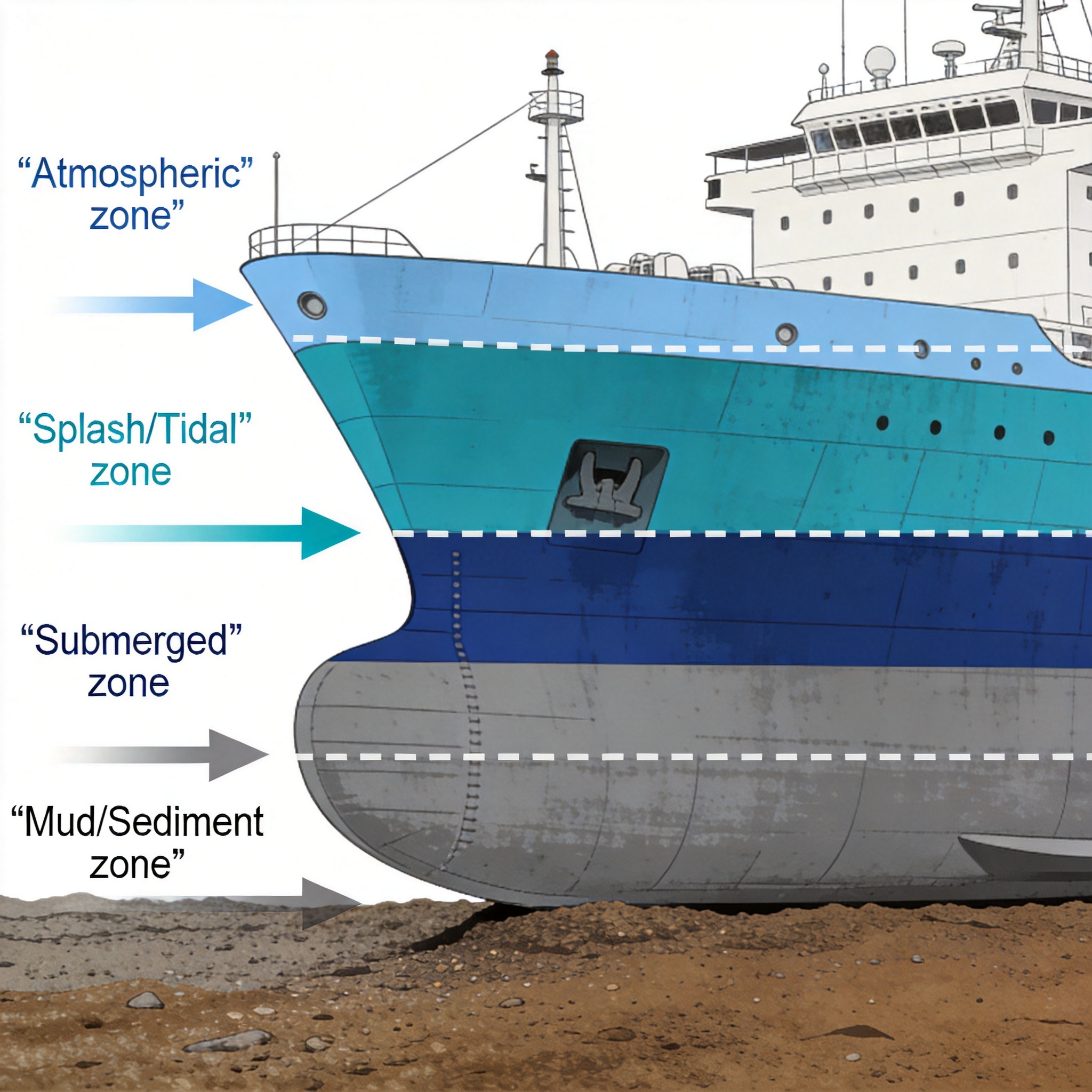
- 1500+ hours — premium-grade coatings for extreme saltwater corrosion zones, typically specified for subsea or splash-zone bolted joints.
The jump from 500h to 1000h is not simply "double the life." In practice, a 1000-hour salt spray result indicates a thicker, more uniform zinc coating with significantly better adhesion — which translates to longer service life in actual marine environments.

Which Standards Require Which Hours?
Different marine engineering specifications set different minimum salt spray test hours for fastener coatings:
- ISO 1461 (hot-dip galvanizing) — typically requires 500h minimum for coating thickness ≥70 μm, which covers most M16+ structural bolts
- EN 14399 (preloaded structural bolt assemblies) — references ISO 1461 for coating, so 500h applies as baseline
- NORSOK M-630 / M-650 (offshore oil & gas) — often requires 1000h or more for critical bolting in splash zones
- Customer specifications — many EPC contractors specify 1000h as their minimum for all marine-grade fasteners
Understanding which corrosion standard applies to your project prevents over-specification (paying for unnecessary coating) or under-specification (risking premature bolt failure).
What Salt Spray Hours Do NOT Tell You
While salt spray test hours are useful for comparing coatings, they have important limitations:
- Real-world correlation is imperfect. A bolt that passes 1000h in the lab may corrode faster in an actual marine environment due to UV exposure, mechanical stress, and cyclic wet-dry conditions.
- Coating thickness matters more than hours alone. Two hot-dip galvanized bolts with the same salt spray rating can have very different zinc distribution if the dipping process differs.
- Hydrogen embrittlement risk is not detected by salt spray tests. High-strength 10.9 and 12.9 bolts require separate baking procedures after galvanizing.
Smart fastener procurement combines salt spray testing with coating thickness measurement (per ISO 1461 Table 3), material certification, and hydrogen embrittlement relief records.

How to Specify the Right Coating for Marine Projects
Follow these three steps when specifying corrosion protection for ship hull bolts:
- Identify the corrosion category per ISO 12944. Marine environments typically fall into C4 (high) or C5-M (very high, marine).
- Match the minimum salt spray hours to the category: C4 → 500h minimum; C5-M → 1000h minimum.
- Verify coating thickness with magnetic gauge readings per ISO 1461. For M20+ structural bolts, minimum local thickness is 85 μm.
SINOFASTENER (Zhonglian Fastener) supplies hot-dip galvanized fasteners tested per ASTM B117 and ISO 9227, with full coating certification and EN 14399 / EN 15048 compliance for preloaded structural connections. Every shipment includes third-party test reports documenting salt spray test hours, coating thickness, and mechanical properties.
Summary
Salt spray test hours are a practical benchmark for comparing bolt coating quality. 500h suits general-purpose applications, while 1000h is the threshold for marine and offshore fasteners. However, always combine salt spray data with coating thickness verification and material traceability to ensure long-term corrosion protection in demanding marine environments.
Frequently Asked Questions
Q1: How many salt spray test hours are required for marine fasteners?
Most marine and offshore specifications require a minimum of 1000 hours per ASTM B117 or ISO 9227 for hot-dip galvanized structural bolts. General-purpose applications in mild environments may accept 500 hours.
Q2: Does a higher salt spray test hour guarantee longer service life?
Not necessarily. Salt spray test hours measure performance in a controlled lab environment. Real-world service life depends on additional factors including UV exposure, mechanical loading, and cyclic wet-dry conditions that the lab test does not replicate.
Q3: What is the difference between ASTM B117 and ISO 9227 salt spray tests?
Both standards use the same 5% NaCl solution at 35°C and produce comparable results. ASTM B117 is primarily used in the Americas and Asia, while ISO 9227 is the European equivalent for CE-marked fastener products.
Q4: Can salt spray testing detect hydrogen embrittlement in high-strength bolts?
No. Salt spray testing only evaluates coating corrosion resistance. Hydrogen embrittlement in 10.9 and 12.9 grade bolts requires separate testing procedures including delayed fracture testing after galvanizing and baking.
Q5: How does coating thickness affect salt spray test results?
Thicker zinc coatings generally produce higher salt spray test hours. Per ISO 1461, hot-dip galvanized bolts M16 and above should have a minimum local coating thickness of 70 μm, which typically correlates to 500+ hours of salt spray resistance.
Bolt Lubrication Effect: Torque Tension Guide for Marine Fasteners
Preload Loss in Bolted Joints: Marine Causes & Prevention Guide | SINOFASTENER