
Marine Fastener Corrosion Protection: Complete Guide to Coatings, Materials & Cathodic Protection
Marine Fastener Corrosion Protection: Complete Guide to Coatings, Materials & Cathodic Protection
Saltwater is the most aggressive common environment for steel fasteners. A bolt that lasts 50 years in a dry warehouse can fail in 18 months when exposed to ocean spray. This comprehensive guide covers everything marine engineers and procurement specialists need to know about protecting fasteners from corrosion in shipbuilding and offshore applications.
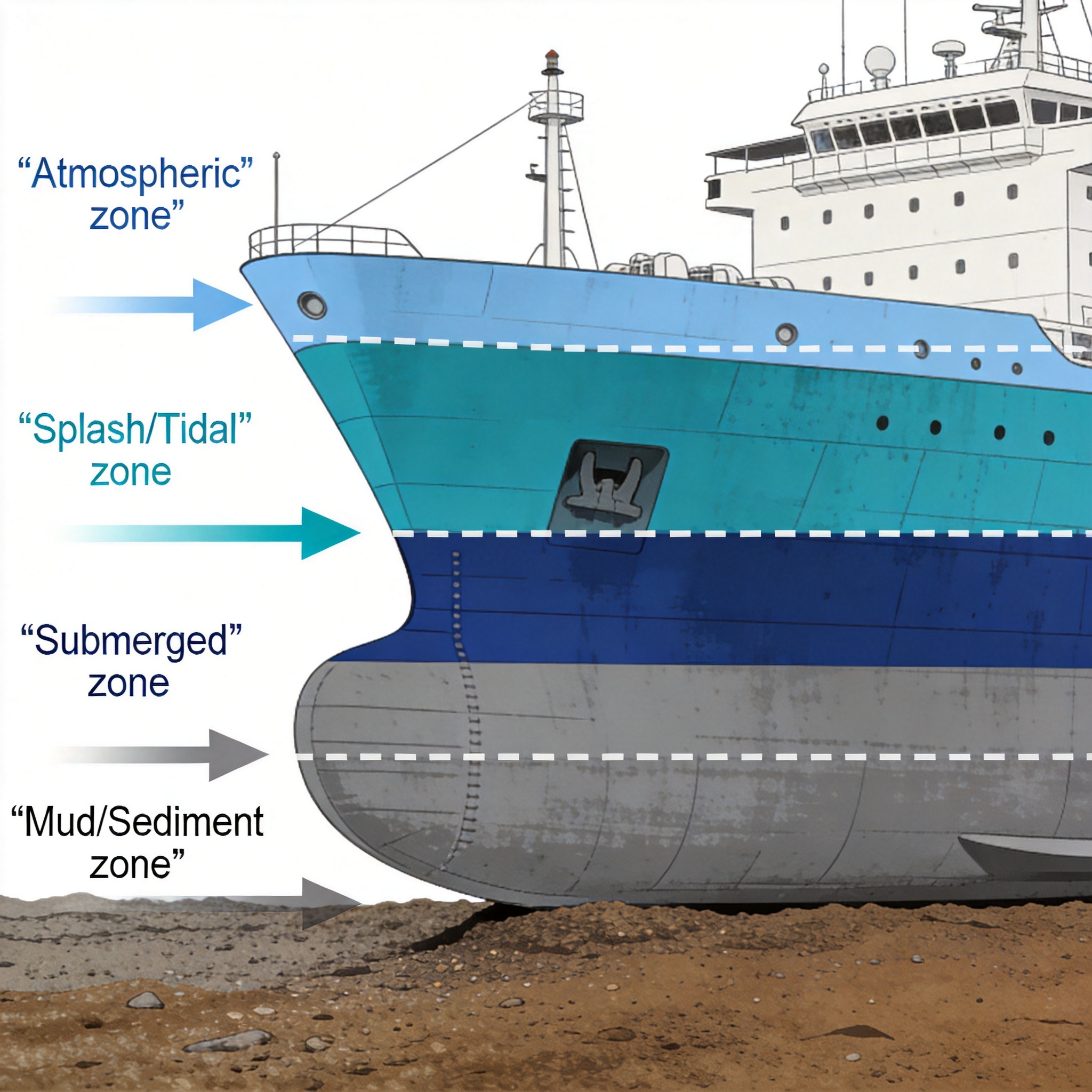
Marine Corrosion Zones Explained
Marine environments are not uniform. Corrosion severity varies dramatically depending on the specific zone where a fastener is installed. Understanding these zones is the first step in selecting the right corrosion protection strategy.
The Four Marine Corrosion Zones
| Zone | Location | Corrosion Rate (Carbon Steel) | Key Factors |
|---|---|---|---|
| Atmospheric | Above splash zone, exposed to salt air | 50-100 μm/year | Salt deposition, humidity, UV, temperature cycles |
| Splash/Tidal | Wave splash area, intermittently wet | 200-500 μm/year | Wet-dry cycles, oxygen availability, mechanical impact |
| Submerged | Below waterline, continuously immersed | 100-200 μm/year | Water temperature, salinity, pollution, marine growth |
| Mud/Sediment | Below seabed, in sediment | 20-80 μm/year | Anaerobic bacteria, sulfides, low oxygen |
Critical insight: The splash zone is actually the most aggressive environment for fasteners, not the submerged zone. The constant wet-dry cycling provides both the electrolyte (saltwater) and oxygen needed for rapid corrosion. Fasteners in this zone require the highest level of protection.
Coating Systems Comparison for Marine Fasteners
Coating is the first line of defense against corrosion. Here's a detailed comparison of the most common coating systems used on marine fasteners:
Hot Dip Galvanizing (HDG)
- Thickness: 45-85 microns
- Salt spray resistance: 500-1,000+ hours
- Marine lifespan: 20-50 years (atmospheric), 10-25 years (submerged)
- Best for: Hull structure, deck fittings, mooring equipment
- Limitations: Not suitable for Grade 10.9+ high-strength bolts (temperature affects mechanical properties)
Dacromet / Geomet (Zinc Flake Coating)
- Thickness: 8-12 microns
- Salt spray resistance: 480-1,000 hours
- Marine lifespan: 10-20 years (atmospheric)
- Best for: High-strength bolts (Grade 10.9/12.9), engine room applications
- Advantages: No hydrogen embrittlement, excellent adhesion, maintains thread fit
Mechanical Galvanizing
- Thickness: 25-50 microns
- Salt spray resistance: 300-600 hours
- Marine lifespan: 15-30 years (atmospheric)
- Best for: High-strength bolts where HDG is not suitable
- Advantages: Room temperature process, no hydrogen embrittlement risk
Thermal Spray Aluminum (TSA)
- Thickness: 100-200 microns
- Salt spray resistance: 2,000-5,000+ hours
- Marine lifespan: 30-50+ years (all zones)
- Best for: Offshore platforms, critical structural connections
- Limitations: High cost, requires specialized application equipment
Coating Comparison Table
| Coating Type | Thickness | Salt Spray (hrs) | Cost Index | Best Application |
|---|---|---|---|---|
| Hot Dip Galvanizing | 45-85 μm | 500-1,000+ | 1.2x | Hull, deck, mooring |
| Dacromet/Geomet | 8-12 μm | 480-1,000 | 1.3x | High-strength bolts, engine room |
| Mechanical Galvanizing | 25-50 μm | 300-600 | 1.25x | Grade 10.9+ bolts |
| Thermal Spray Aluminum | 100-200 μm | 2,000-5,000+ | 2.5x | Offshore critical structures |
| Epoxy Coating | 200-400 μm | 1,000-3,000 | 1.8x | Subsea pipelines, risers |
Material Selection Guide for Marine Fasteners
When coatings alone are not sufficient, or when the application requires inherent corrosion resistance, material selection becomes critical. Here's how different materials perform in marine environments:
Carbon Steel + Coating
- Cost: Lowest
- Strength: Up to Grade 12.9
- Corrosion resistance: Depends entirely on coating
- Best for: Most ship applications with proper coating selection
- Maintenance: Regular inspection and recoating required
304 Stainless Steel (A2)
- Cost: 3-4x carbon steel
- Strength: Grade 70 (A2-70)
- Corrosion resistance: Good in atmospheric, poor in submerged/splash
- Best for: Interior ship applications, galley, accommodation areas
- Limitations: Susceptible to crevice corrosion and pitting in saltwater
316 Stainless Steel (A4)
- Cost: 4-5x carbon steel
- Strength: Grade 70 (A4-70)
- Corrosion resistance: Better than 304, still vulnerable in splash zone
- Best for: Deck fittings, railings, non-critical exterior applications
- Limitations: Can suffer from crevice corrosion under gaskets/washers
2205 Duplex Stainless Steel
- Cost: 6-8x carbon steel
- Strength: Grade 80 (higher than 316)
- Corrosion resistance: Excellent in all marine zones
- Best for: Critical structural connections, offshore platforms
- Advantages: Higher strength allows smaller fastener sizes
2507 Super Duplex Stainless Steel
- Cost: 10-12x carbon steel
- Strength: Grade 100
- Corrosion resistance: Superior in all marine zones, including high-temperature
- Best for: Subsea applications, high-pressure systems, extreme environments
- Advantages: Best combination of strength and corrosion resistance
Material Performance by Marine Zone
| Material | Atmospheric | Splash Zone | Submerged | Relative Cost |
|---|---|---|---|---|
| Carbon Steel + HDG | Excellent | Good | Fair | 1x |
| 304 SS (A2) | Good | Poor | Poor | 3-4x |
| 316 SS (A4) | Excellent | Fair | Poor | 4-5x |
| 2205 Duplex | Excellent | Excellent | Good | 6-8x |
| 2507 Super Duplex | Excellent | Excellent | Excellent | 10-12x |
| Cu-Ni Alloy | Excellent | Excellent | Excellent | 15-20x |
Cathodic Protection & Fasteners
Most ships use cathodic protection (CP) systems to protect the hull from corrosion. These systems can significantly impact fastener performance, both positively and negatively.
How Cathodic Protection Works
Cathodic protection works by making the protected structure (ship hull) the cathode of an electrochemical cell. This is achieved either through:
- Sacrificial anodes: Zinc or aluminum blocks attached to the hull that corrode preferentially
- Impressed current: External power source forces current through inert anodes
Impact on Fasteners
Positive effects:
- Fasteners electrically connected to the hull receive some protection from the CP system
- Submerged fasteners in well-protected areas may show minimal corrosion even without coating
Negative effects:
- Over-protection: Excessive CP voltage can cause hydrogen embrittlement in high-strength steel fasteners (Grade 8.8+)
- Galvanic corrosion: If fasteners are more noble than the hull material, they can accelerate hull corrosion
- Coating disbondment: High CP currents can cause cathodic disbondment of organic coatings
Best Practices for Fasteners in CP Systems
- Use fasteners with similar electrochemical potential to the hull material
- Avoid mixing different metals in the same connection (prevent galvanic couples)
- For high-strength bolts (Grade 10.9+), monitor hydrogen embrittlement risk
- Ensure coating system is compatible with CP (epoxy coatings generally work well)
- Regular inspection of both fasteners and anode consumption rate
Case Study: Fleet-Wide Fastener Corrosion Analysis
A 2022 study of a 12-vessel container ship fleet revealed critical insights about fastener corrosion in real-world marine operations:
Study Parameters
- Fleet size: 12 container ships (8-12 years old)
- Fasteners inspected: 2,400+ connection points
- Inspection method: Visual, ultrasonic thickness measurement, torque testing
Key Findings
| Fastener Type | Location | Failure Rate (8 years) | Primary Failure Mode |
|---|---|---|---|
| Electro-galvanized Grade 8.8 | Deck fittings | 67% | Severe corrosion, section loss |
| HDG Grade 8.8 | Hull structure | 12% | Minor surface corrosion |
| 304 SS A2-70 | Accommodation | 8% | Crevice corrosion under washers |
| 316 SS A4-70 | Deck railings | 23% | Pitting in splash zone |
| Grade 10.9 + Dacromet | Engine room | 5% | Minimal corrosion, some loosening |
Recommendations from Study
- Replace all electro-galvanized fasteners in exterior applications with HDG or Dacromet
- Implement 5-year inspection cycle for all critical structural connections
- Use 316 SS only in atmospheric zones, not in splash or submerged areas
- Consider duplex stainless steel for newbuild vessels in critical applications
- Maintain detailed corrosion records for each vessel to predict replacement needs
Selection Matrix by Ship Area
Use this matrix to quickly identify the recommended fastener solution for different areas of a ship:
| Ship Area | Environment | Recommended Fastener | Alternative |
|---|---|---|---|
| Hull structure (below waterline) | Submerged + CP | HDG Grade 8.8 | Epoxy-coated Grade 8.8 |
| Deck structure | Splash/Atmospheric | HDG Grade 8.8 | 2205 Duplex for critical |
| Mooring equipment | Splash zone | HDG Grade 10.9 | Dacromet Grade 10.9 |
| Engine room | Indoor, high temp | Dacromet Grade 10.9 | 304 SS for non-structural |
| Accommodation | Indoor, controlled | Electro-galvanized Grade 8.8 | 304 SS A2-70 |
| Cargo hold (dry bulk) | Atmospheric, abrasive | HDG Grade 8.8 | Hardened steel + coating |
| Pipeline flanges | Varies by medium | Per ASME B16.5 | 316 SS for seawater |
| Offshore crane | Splash + dynamic load | 2205 Duplex Grade 80 | HDG Grade 10.9 + frequent inspection |
Frequently Asked Questions
What is the best coating for marine fasteners?
Hot dip galvanizing (HDG) offers the best balance of cost and performance for most marine applications. For high-strength bolts (Grade 10.9+), Dacromet or mechanical galvanizing are preferred. For extreme environments, thermal spray aluminum provides the longest service life.
Can I use stainless steel bolts on a ship?
Yes, but with important limitations. 304 SS is suitable for interior applications. 316 SS works well in atmospheric zones but can suffer from crevice corrosion in splash zones. For critical submerged or splash zone applications, duplex stainless steel (2205 or 2507) is recommended.
How often should marine fasteners be inspected?
Critical structural connections should be inspected every 5 years or during each special survey (whichever comes first). Non-critical fasteners can be inspected every 10 years. Fasteners in splash zones or high-corrosion areas may need more frequent inspection (every 2-3 years).
Does cathodic protection protect fasteners?
Yes, fasteners electrically connected to a cathodically protected hull receive some protection. However, over-protection can cause hydrogen embrittlement in high-strength bolts, and galvanic incompatibility can accelerate corrosion. Proper material selection and monitoring are essential.
What is the most common cause of fastener failure on ships?
Corrosion is the leading cause, accounting for approximately 60% of fastener failures in marine environments. The most vulnerable locations are splash zones and areas where dissimilar metals are in contact (galvanic corrosion). Proper coating selection and regular maintenance can prevent most failures.
How do I prevent galvanic corrosion between fasteners and hull?
Use fasteners with similar electrochemical potential to the hull material. Avoid mixing different metals in the same connection. If dissimilar metals must be used, insulate them with non-conductive washers or sleeves. Apply compatible coating systems to both materials.
Wet Torque vs Dry Torque: How Bolt Lubrication Affects Clamp Force Accuracy
Hot Dip Galvanized vs Electro-Galvanized Bolts: Marine Selection Guide | SINOFASTENER


