
A4-80 vs A2-70 Stainless Steel Bolts: Which One for Marine Applications?

A4-80 vs A2-70 Stainless Steel Bolts: Which One for Marine Applications?
Introduction
If you are specifying bolts for a ship, offshore platform, or any marine structure, you have probably faced this question: should I use A4-80 or A2-70 stainless steel bolts?
Both grades look identical. Both are "stainless steel." But the difference between them can mean the difference between a 20-year service life and a bolt that starts corroding in 2 years.
This article gives you a direct, practical comparison so you can make the right choice for your specific application. No fluff, just the facts you need.
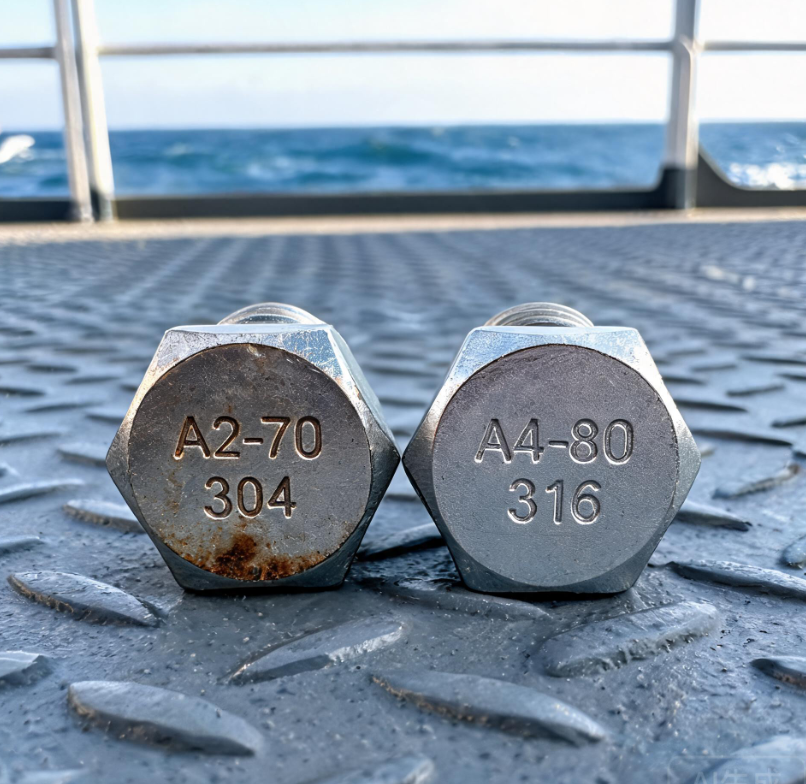
What Do A4-80 and A2-70 Actually Mean?
Before comparing, let us decode the grade markings:
| Grade | Steel Type | Min. Tensile Strength | Common Name |
|---|---|---|---|
| A2-70 | Austenitic stainless steel (304/1.4301) | 700 MPa | "Marine grade" (but not really) |
| A4-80 | Austenitic stainless steel (316/1.4401) | 800 MPa | True marine grade |
[Source: ISO 3506-1:2020 - Mechanical properties of corrosion-resistant stainless steel fasteners]
The key difference is the steel composition, specifically the molybdenum content:
- A2 (304): 18% Chromium, 8% Nickel, 0% Molybdenum
- A4 (316): 18% Chromium, 10% Nickel, 2-3% Molybdenum
That 2-3% molybdenum is what makes A4-80 resistant to chloride attack from seawater. Without it, A2-70 is vulnerable.
Corrosion Resistance: The Real Difference
This is where the two grades diverge dramatically in marine environments:
| Corrosion Type | A2-70 (304) | A4-80 (316) |
|---|---|---|
| Atmospheric (coastal) | Good | Excellent |
| Splash zone | Fair (risk of pitting) | Good |
| Submerged (seawater) | Poor (pitting likely) | Fair to Good |
| Crevices (under gaskets) | Poor (crevice corrosion) | Fair |
| High temperature seawater | Poor | Fair (consider duplex) |
[Source: ISO 9223:2012 - Corrosion of metals and alloys; NACE International corrosion data]
Why A2-70 Fails in Seawater
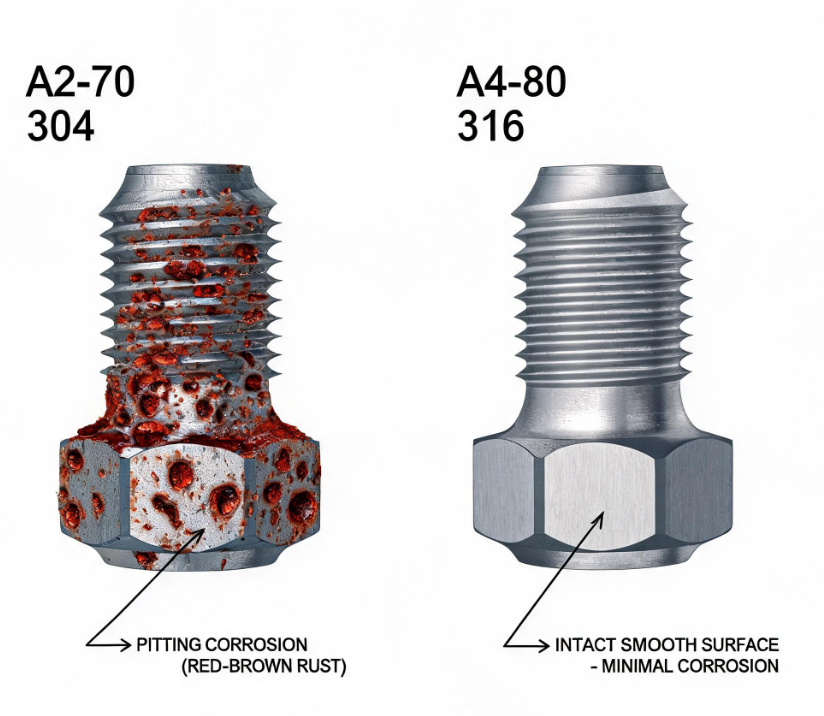
A2-70 lacks molybdenum, which means chloride ions from seawater can break down the passive oxide layer on the bolt surface. Once this layer is compromised, pitting corrosion starts - small, deep holes that can cause sudden bolt failure.
A4-80's molybdenum content stabilizes the passive layer, making it much more resistant to chloride attack. It is not immune, but it lasts significantly longer.
Strength Comparison
Strength matters for structural connections. Here is how they compare:
| Property | A2-70 | A4-80 | Difference |
|---|---|---|---|
| Tensile Strength | 700 MPa | 800 MPa | A4-80 is 14% stronger |
| Yield Strength (0.2% offset) | 450 MPa | 600 MPa | A4-80 is 33% stronger |
| Hardness (HV) | 210-310 | 250-350 | A4-80 slightly harder |
| Elongation at break | 0.6d min | 0.4d min | A2-70 slightly more ductile |
[Source: ISO 3506-1:2020 Table 3 - Mechanical properties of austenitic steel fasteners]
A4-80 is not only more corrosion resistant, it is also stronger. For structural connections on ships, this makes A4-80 the safer choice.
Price Difference: Is A4-80 Worth the Extra Cost?
Yes, A4-80 costs more than A2-70. But how much more?
| Factor | A2-70 | A4-80 |
|---|---|---|
| Material cost | Baseline | 20-40% higher |
| Service life (marine) | 2-5 years | 10-20 years |
| Replacement frequency | Every 3-5 years | Every 10-15 years |
| Total cost over 15 years | 3x replacement cost | 1x replacement cost |
While A4-80 costs 20-40% more upfront, the total cost of ownership over 15 years is typically lower because you replace bolts far less often. For critical structural connections, the choice is clear.
Quick Decision Guide
Use A4-80 when:
- Bolts are exposed to seawater or salt spray
- Connection is structural (hull, deck, mast)
- Access for maintenance is difficult
- Failure would be safety-critical
A2-70 is acceptable when:
- Bolts are indoors or in dry areas
- Application is non-structural (trim, fittings)
- Regular inspection and replacement is planned
- Budget is extremely constrained
Common Mistakes to Avoid
Mistake 1: Using A2-70 Below the Waterline
A2-70 will pit and corrode quickly in submerged seawater. Always use A4-80 or higher grade for below-waterline applications.
Mistake 2: Mixing A2 and A4 Bolts in the Same Connection
Mixing different stainless steel grades can create galvanic corrosion. The less noble metal (A2) will corrode faster. Always use the same grade throughout a connection.
Mistake 3: Assuming "Stainless" Means "Never Rusts"
All stainless steel can corrode in harsh environments. A4-80 is more resistant, but still requires proper selection, installation, and maintenance.
Standards and Certifications
When procuring marine bolts, ensure they comply with relevant standards:
- ISO 3506-1:2020 - Mechanical properties of corrosion-resistant stainless steel fasteners
- ISO 4014 / DIN 931 - Hex head bolt dimensions
- DNV GL - Marine and offshore certification (for structural applications)
- ABS / LR / BV - Other major classification society certifications
[Source: ISO 3506-1:2020; DNV-OS-B101 Metallic Materials]
For structural connections on commercial vessels, classification societies typically require A4-80 minimum for any bolt exposed to marine atmosphere or seawater.
Summary: A4-80 vs A2-70 at a Glance
| Criteria | A2-70 | A4-80 | Winner |
|---|---|---|---|
| Corrosion resistance (marine) | Fair | Good | A4-80 |
| Tensile strength | 700 MPa | 800 MPa | A4-80 |
| Yield strength | 450 MPa | 600 MPa | A4-80 |
| Price | Lower | 20-40% higher | A2-70 |
| Service life (marine) | 2-5 years | 10-20 years | A4-80 |
| Best for | Dry, indoor, non-structural | Marine, structural, critical | Depends on application |
Bottom line: For marine applications, A4-80 is almost always the right choice. The extra 20-40% upfront cost pays for itself many times over in reduced maintenance and replacement costs.
Frequently Asked Questions
Q1: Can I use A2-70 bolts on a boat?
A1: Only for non-structural, indoor, or dry applications. For any bolt exposed to seawater, salt spray, or marine atmosphere, use A4-80 minimum. A2-70 will corrode quickly in these conditions.
Q2: Is A4-80 the same as 316 stainless steel?
A2: Yes. A4 corresponds to AISI 316 stainless steel (1.4401 in European designation). The "80" indicates minimum tensile strength of 800 MPa.
Q3: How much more does A4-80 cost compared to A2-70?
A3: A4-80 typically costs 20-40% more than A2-70 due to the molybdenum content. However, the total cost of ownership over 15 years is usually lower due to longer service life.
Q4: Can I mix A2-70 and A4-80 bolts in the same connection?
A4: No. Mixing different stainless steel grades creates galvanic corrosion risk. The less noble metal (A2-70) will corrode faster. Always use the same grade throughout a connection.
Q5: Do marine bolts need DNV certification?
A5: For structural connections on commercial vessels classified by DNV, ABS, LR, or other societies, yes. Classification rules typically require certified fasteners for hull, deck, and critical structural connections. For non-structural or recreational applications, certification may not be required.
Hot Dip Galvanized vs Electro-Galvanized Bolts: Marine Selection Guide | SINOFASTENER
Bolt Lubrication Effect: Why Dry vs Oiled Changes Everything


