Bolt Lubrication Effect: Torque Tension Guide for Marine Fasteners
Bolt Lubrication Effect: Why Dry vs Oiled Changes Everything
Two identical marine bolts tightened to the same torque value can develop preload forces that differ by more than 40%. The only variable between them? Whether the threads were dry or lubricated during installation. This bolt lubrication effect is one of the most overlooked factors in marine fastener assembly, yet it directly determines whether a joint holds under vibration or loosens within weeks.
Understanding how friction interacts with torque application is essential for every marine engineer, shipyard technician, and offshore maintenance supervisor. This guide breaks down the mechanics, the numbers, and the practical implications.

The Torque-Preload Relationship: Where Friction Enters
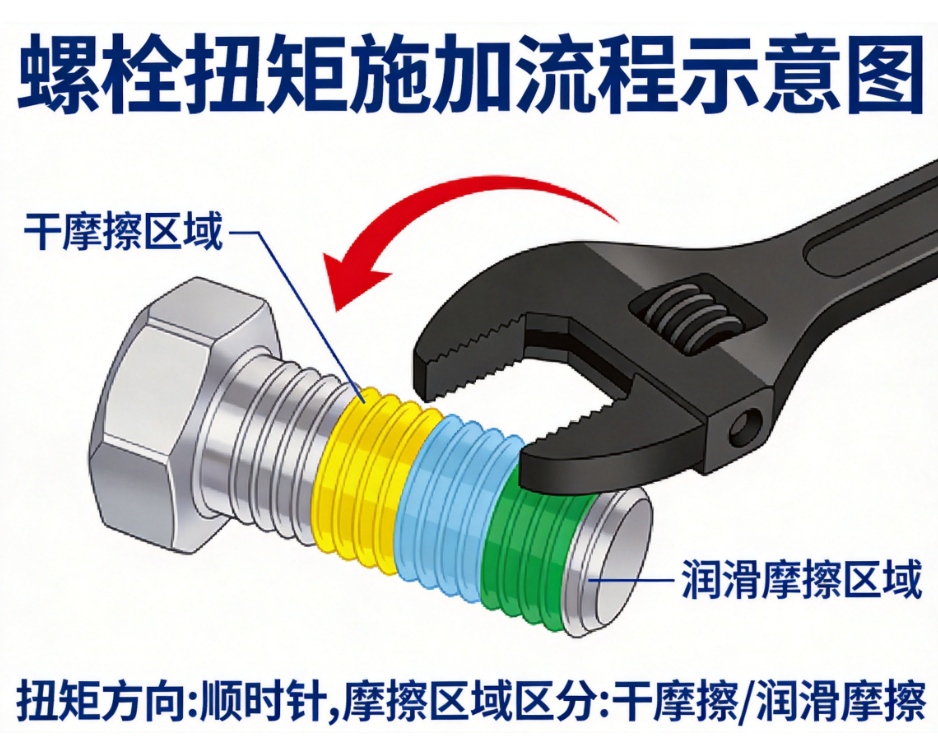
When you apply torque with a torque wrench, only about 10–15% of that energy actually converts into useful preload (clamping force) on the bolt. The remaining 85–90% is consumed by friction — split roughly 50% under the bolt head and 40% in the thread engagement zone.
The relationship is expressed by the standard torque equation:
T = K × D × F
Where T = applied torque (N·m), K = nut factor (friction coefficient), D = nominal bolt diameter (m), and F = target preload (N).
The nut factor K is where bolt lubrication makes all the difference. For a dry, as-received carbon steel bolt, K typically ranges from 0.20 to 0.25. Apply a thread lubricant or anti-seize compound, and K drops to 0.12–0.16. That single change means the same torque produces 30–50% more clamp load.
Friction Coefficient Values: Dry vs Lubricated
The table below shows typical friction coefficient ranges for common marine bolt conditions, based on data from ASME PCC-1 and industrial fastener manufacturers:
| Surface Condition | Nut Factor (K) | Preload Deviation vs Dry |
|---|---|---|
| Dry, unplated (as-received) | 0.20 – 0.25 | Baseline |
| Dry, hot-dip galvanized | 0.25 – 0.30 | −10% to −20% |
| Light oil film | 0.14 – 0.18 | +25% to +40% |
| Anti-seize compound (copper/nickel) | 0.12 – 0.16 | +35% to +55% |
| PTFE-based thread lubricant | 0.10 – 0.14 | +50% to +70% |
| Molybdenum disulfide (MoS₂) | 0.08 – 0.12 | +60% to +90% |
These numbers reveal why the same torque specification cannot be applied blindly across different bolt surface treatments. A hot-dip galvanized bolt installed dry requires higher torque than the same bolt lightly oiled — and a stainless steel fastener with anti-seize can be dangerously over-tightened if the torque value was set for dry conditions.
Why Lubrication Matters More in Marine Environments
On land, an over-tightened bolt might cause gradual creep or thread deformation. At sea, the consequences are amplified by vibration, thermal cycling, and saltwater corrosion:
- Vibration loosening: Under cyclic loading from engine vibration and wave action, an under-preloaded marine bolt will experience self-loosening (rotation back) far faster than a properly preloaded joint. The lubrication effect directly controls whether the initial preload is adequate.
- Galling in stainless steel: Stainless steel bolts (A2/A4 grades) are notorious for galling during installation. Without proper lubrication, the passive oxide layer breaks down, cold-welding occurs, and the bolt seizes — often leading to thread destruction or the need for cutting.
- Galvanic friction changes: In mixed-material joints (e.g., galvanized bolts in aluminum frames), corrosion products build up between faying surfaces, gradually altering the friction coefficient over time and changing the clamp load retention.
- Temperature extremes: Engine room fasteners experience temperatures from −20°C to +200°C. Many lubricants degrade or carbonize at high temperatures, reverting to dry friction conditions mid-service and losing preload.
Common Marine Lubricants and Their Applications
Not all bolt lubricants are interchangeable. The choice depends on the fastener material, operating temperature, and whether the joint will be disassembled:
| Lubricant Type | Best For | Temp Range | K Factor |
|---|---|---|---|
| Light machine oil | General assembly, temporary protection | −20°C to +80°C | 0.14–0.18 |
| Copper anti-seize compound | High-temp exhaust bolts, dissimilar metals | −30°C to +650°C | 0.12–0.16 |
| Nickel anti-seize | Stainless steel, marine grade applications | −30°C to +800°C | 0.11–0.15 |
| PTFE (Teflon) paste | Precision torque applications, instrument bolts | −50°C to +260°C | 0.10–0.14 |
| Molybdenum disulfide (MoS₂) | High-pressure, structural bolt connections | −40°C to +400°C | 0.08–0.12 |
For marine fastener applications, copper or nickel anti-seize compounds are the most commonly specified because they handle the full range of sea-going conditions while preventing galvanic corrosion between dissimilar metals.
The Danger of Ignoring Lubrication State
Consider a real-world scenario: a flange connection on a marine piping system is torqued to 450 N·m per the engineering specification. The bolts are 316 stainless steel, M20 × 2.5, property class A4-80.
During initial commissioning, the bolts were installed dry (K ≈ 0.22). Six months later, during maintenance, replacement bolts are installed with nickel anti-seize (K ≈ 0.13) — but the same 450 N·m torque is applied. The result:
- The lubricated bolts achieve approximately 65% more preload than designed
- This exceeds the bolt's yield point, causing plastic deformation in the threads
- Under vibration, the over-stretched bolt relaxes and loses clamp force within days
- The joint leaks. The flange gasket compresses unevenly. Re-torque attempts fail because the threads are damaged.
This is not a hypothetical case — it is one of the most common causes of bolt joint failure in marine maintenance. The bolt lubrication effect is not a minor detail; it is a load-bearing variable in every torque specification.

Practical Rules for Marine Bolt Lubrication
Based on the mechanics above, here are the rules that every marine maintenance team should follow:
Rule 1: Never mix dry and lubricated torque values. If the spec says 450 N·m dry, applying 450 N·m with lubricant is a recipe for bolt failure.
Rule 2: Always document the lubrication state in the torque specification. "Tighten to 450 N·m" is incomplete — it must read "Tighten to 450 N·m on dry, as-received threads" or "on lubricated threads with [product name]."
Rule 3: For stainless steel fasteners in marine environments, always use anti-seize compound. The cost of galling (cut bolts, damaged threads, downtime) far exceeds the cost of lubricant.
Rule 4: When replacing bolts in an existing joint, match the lubrication condition of the original installation — or recalculate the torque for the new condition using the correct nut factor.
Rule 5: Re-inspect preload after 24 hours of service on critical joints. Thermal cycling and initial seating can reduce clamp load by 5–10% regardless of lubrication.
Choosing the Right Fastener Supplier
Consistent friction coefficients start with consistent manufacturing. SINOFASTENER produces marine fasteners — including A4-80 stainless steel bolts, hot-dip galvanized heavy hex bolts, and alloy steel ASTM A193 B7/B16 studs — with controlled surface finishes that ensure predictable torque-preload behavior.
Our fasteners are manufactured per ASTM A194, EN 15048, and ISO 898-1 standards, with full material traceability and mill test certificates. Whether you need standard hex bolts or custom-length stud assemblies for flange connections, we deliver consistent quality that makes your torque specifications reliable — every time.
SINOFASTENER — Marine Fastener Solutions
Brand Site: www.zlfastener.com
Email: sales@sinofastener.com
Corporate: www.sinofastener.com | Tel: 0086-574-86592087
FAQ
How does bolt lubrication affect torque?
Bolt lubrication reduces the friction coefficient between threads and under the bolt head, meaning less torque energy is wasted overcoming friction. The same torque applied to a lubricated marine bolt produces 30–70% more preload than the same torque on a dry bolt.
What is the nut factor (K value) for dry marine bolts?
For dry, unplated carbon steel bolts, the nut factor K is typically 0.20–0.25. For hot-dip galvanized bolts, it rises to 0.25–0.30. These values are referenced in ASME PCC-1 and are essential for calculating accurate torque specifications.
Should I use anti-seize on stainless steel marine bolts?
Yes. Stainless steel fasteners (A2/A4 grades) are highly susceptible to galling in marine environments. Using a nickel or copper anti-seize compound prevents cold-welding and thread damage during installation while reducing the friction coefficient for predictable preload.
Can I use the same torque value for lubricated and dry bolts?
No. Mixing lubrication states with the same torque value is one of the most common causes of bolt joint failure. Lubricated bolts will be over-tightened (exceeding yield), and dry galvanized bolts will be under-tightened (insufficient clamp load).
What lubricant is best for marine bolt applications?
For most marine fastener applications, copper or nickel anti-seize compound provides the best balance of friction reduction, temperature resistance, and corrosion protection. PTFE pastes are preferred for precision instrument bolts, and MoS₂ for high-pressure structural connections.
A4-80 vs A2-70 Stainless Steel Bolts: Which One for Marine Applications?
Salt Spray Test Hours Explained: What 500h vs 1000h Really Means