

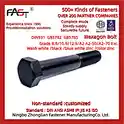

PTFE Coated Hex Bolt Grade 8.8 Marine Anti-Corrosion
PTFE Coated Hex Bolt — Grade 8.8 Carbon Steel, Anti-Corrosion for Marine Service
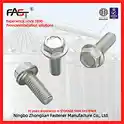
ThePTFE coated hex bolt is a high-strength Grade 8.8 carbon steel hex bolt with a fluoropolymer surface coating that combines the mechanical strength of alloy steel with the chemical inertness and corrosion barrier of PTFE (polytetrafluoroethylene). On marine vessels, PTFE coated bolts are deployed in corrosive service areas where standard zinc-plated or HDG bolts degrade prematurely — cooling water pipe flanges, ballast tank access hatches, deck drainage fittings, exhaust scrubber connections, and chemical dosing system manifolds.
Unlike metallic coatings (zinc, HDG) that protect through sacrificial anode action and gradually consume, the PTFE fluoropolymer coating creates a chemically inert physical barrier that resists salt water, mild acids, alkalis, and UV exposure without degradation. The coating also provides a low friction surface (coefficient of friction approximately 0.15–0.20), which reduces galling during assembly and allows easier disassembly during maintenance — a practical advantage on bolted joints that must be opened regularly for inspection.
sinofastener supplies PTFE coated hex bolts in Grade 8.8 (quenched and tempered carbon steel), covering metric sizes M6 through M24. Standard hex bolt dimensions per ISO 4014 (partial thread) and ISO 4017 (full thread).
Why PTFE Coating Over Standard Zinc or HDG
| Property | PTFE Coated | HDG (Hot-Dip Galvanized) | Zinc Plated |
|---|---|---|---|
| Protection Mechanism | Inert physical barrier — no consumption | Sacrificial zinc anode — gradually consumed | Thin zinc layer — limited sacrificial life |
| Chemical Resistance | Excellent — resistant to salt water, mild acids, alkalis, solvents | Moderate — zinc corrodes in acidic or alkaline environments | Limited — thin coating provides minimal chemical barrier |
| UV Stability | High — PTFE is inherently UV resistant | Good — zinc patina stable under UV | Poor — thin zinc degrades under continuous UV |
| Friction Coefficient | ~0.15–0.20 (self-lubricating surface) | ~0.35–0.45 (rougher surface) | ~0.30–0.40 |
| Service Temperature | -50°C to +290°C | -40°C to +200°C | -40°C to +120°C |
| Salt Spray Resistance | 3000+ hours (ASTM B117) | 500–1000 hours depending on coating thickness | 96–200 hours |
| Disassembly | Easy — low friction prevents seizing | Moderate — zinc can gall over time | Difficult — zinc corrosion products can seize threads |
PTFE Coating Technical Data
| Parameter | Value | Test Standard |
|---|---|---|
| Coating Type | Fluoropolymer (PTFE dispersed in thermoset resin matrix) | — |
| Dry Film Thickness | 25–35 μm | ASTM D7091 |
| Service Temperature | -50°C to +290°C | — |
| Salt Spray (Fog) Resistance | 3000+ hours, no blistering or substrate corrosion | ASTM B117 |
| Friction Coefficient (μ) | Approximately 0.15–0.20 | ASTM D1894 |
| Adhesion | 5B (cross-hatch, no delamination) | ASTM D3359 |
| Color | Typically dark grey/black (may vary by coating formulation) | — |
Marine Applications
- Marine Piping — cooling water, ballast water, and fire main flange bolts where salt-laden condensate causes rapid zinc coating breakdown
- Engine Room — exhaust scrubber connection bolts exposed to sulfur-bearing condensate; fuel oil system manifold bolts resistant to hydrocarbon splash
- Deck Equipment — drainage fitting bolts, hatch coaming fasteners, and deck grating clips in high-splash zones
- Chemical Dosing Systems — manifold bolts on water treatment skids where mild acid or alkali dosing lines create corrosive splash environments
- Ballast Tank Access — hatch cover bolts requiring a coating that resists both saltwater immersion and the mechanical wear of repeated opening for inspection
PTFE Coated vs Stainless Steel: When to Choose Each
| Factor | PTFE Coated Grade 8.8 | A4-80 (316) Stainless |
|---|---|---|
| Tensile Strength | 800 MPa min (Grade 8.8) | 800 MPa min (A4-80) |
| Corrosion Mechanism | Barrier protection — coating shields carbon steel substrate | Inherent resistance — chromium oxide passive layer |
| Coating Damage Risk | If coating is scratched or chipped, bare steel is exposed to corrosion | No coating to damage — passive layer self-heals in oxygen |
| Cost | Lower — carbon steel base + coating is more economical than solid 316 | Higher — premium alloy material cost |
| Best Use Case | Controlled environments where coating integrity can be maintained during installation | Unpredictable environments where mechanical damage to coating is likely |
| Thread Galling | Low risk — PTFE surface provides inherent lubrication | Moderate risk — stainless threads can gall under high torque |
Installation Note
PTFE coated bolts should be handled with nylon-coated tools or padded grips during installation to avoid scratching the coating. If coating damage occurs on the thread or head during assembly, the exposed area should be touched up with a PTFE-compatible repair compound to restore the corrosion barrier. Torque values should be adjusted downward from dry carbon steel values to account for the reduced friction coefficient of the PTFE surface — using standard dry torque values on PTFE coated bolts can result in over-torquing and potential bolt stretch.
Supply and Certification
All PTFE coated hex bolts are manufactured from Grade 8.8 quenched and tempered carbon steel, hot-forged per ISO 4014 (partial thread) or ISO 4017 (full thread) dimensions. Coating applied after thread rolling and heat treatment. Material certificates per EN 10204 3.1. Salt spray test reports available per batch. Third-party inspection coordinated on request.
sinofastener — 36 years of fastener manufacturing. Annual capacity 50,000 tonnes. PTFE coated fasteners available in hex bolts, studs, nuts, and washers for matched assembly supply.
Material: Grade 8.8 Carbon Steel (quenched & tempered)
Coating: PTFE Fluoropolymer, 25–35 μm DFT
Standard: ISO 4014 (partial thread) / ISO 4017 (full thread)
Size Range: M6 – M24
Tensile Strength: 800 MPa min
Thread: Metric coarse, tolerance 6g
E-mail: sales@sinofastener.com | SINOFASTENER