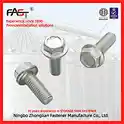


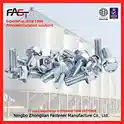
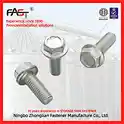
DIN 6921 Hex Flange Bolt A4-70 Serrated Flange Screw
DIN 6921 Hex Flange Bolt — Integrated Washer-Face Flange Screw A4-70
TheDIN 6921 hex flange bolt — also called a flange screworhexagon head bolt with flange — integrates a circular formed washer-flange into the underside of the bolt head. Unlike standard hex bolts that require a separate flat washer to distribute clamping force, the flange bolt delivers immediate, reliable bearing surface contact with a single component. The built-in flange spreads the clamp load over a larger area, protects soft substrates from deformation, and eliminates the assembly step, inventory line item, and potential mismatch of independent washers.
The flange face is available in two types: plain (non-serrated) for general-purpose use where even load distribution is the priority, and serrated flange bolt with 6–12 radial ribs that create mechanical interlock with the mating surface when torqued — providing resistance to vibration loosening without additional locking devices.
Why Flange Bolts Dominate Marine Engine Room Assembly
In marine engine rooms and piping systems, DIN 6921 flange bolts are widely used where speed of assembly and joint integrity are both critical:
- Pipe flange connections: One-piece design eliminates washer loss during alignment — critical in confined machinery compartments where dropped washers fall into inaccessible bilge spaces.
- Pump and motor mounting: Serrated flange face grips the bracket surface under vibration, maintaining preload without spring washers or lock nuts.
- Heat exchanger joints: Wide flange bearing area distributes clamping force evenly across gasket surfaces, preventing gasket blowout at uneven pressure.
- Valve body bolting: Reduces part count from three (bolt + washer + nut) to two (flange bolt + nut), cutting assembly time and procurement SKUs.
- Compressed air manifold covers: Plain flange face provides full bearing on thin cover plates without indentation.
Material Options — Stainless vs Carbon Steel
| Grade | Material | Tensile Strength | Corrosion Resistance | Recommended Application |
|---|---|---|---|---|
| A2-70 | AISI 304 Stainless Steel | 700 MPa | Good (freshwater, indoor) | Interior panels, non-corrosive zones |
| A4-70 | AISI 316 Stainless Steel | 700 MPa | Excellent (seawater, salt spray) | Bilge area, deck exposure, salt-laden atmosphere |
| A4-80 | AISI 316 Cold-Worked | 800 MPa | Excellent (seawater, salt spray) | High-strength marine structural, same corrosion resistance as A4-70 with 14% higher tensile |
| Grade 8.8 | Carbon Steel, quenched & tempered | 800 MPa | Depends on coating | Protected engine room, zinc/Dacromet/Geomet coated |
| Grade 10.9 | Carbon Steel, quenched & tempered | 1040 MPa | Depends on coating | High-preload structural joints, heavy machinery mounting |
Selection guide: For direct seawater exposure or salt-laden engine room atmosphere, choose A4-70 or A4-80. For protected compartments where cost is a factor, Grade 8.8 with Dacromet or Geomet coating provides adequate corrosion protection at lower material cost. Where vibration resistance is critical, specify serrated flange face; for gasket sealing or painted surfaces, specify plain flange face.
Technical Standards
| Standard | Scope |
|---|---|
| DIN 6921 | Hexagon bolts with flange — German national standard (withdrawn, superseded by ISO) |
| ISO 4161 | Hexagon flange bolts — current international standard, dimensionally identical to DIN 6921 |
| ISO 898-1 | Mechanical properties of fasteners — property classes 8.8, 10.9 (carbon steel) |
| ISO 3506-1 | Mechanical properties of stainless steel fasteners — A2-70, A4-70, A4-80 |
Product Specification
| Item | Detail |
|---|---|
| Product Name | DIN 6921 Hex Flange Bolt / Flange Screw |
| Standard | DIN 6921 / ISO 4161 |
| Head Type | Hexagon head with integrated flange (plain or serrated face) |
| Size Range | M5 – M24 |
| Thread | Metric coarse, full-thread / partial-thread options |
| Material — Stainless | A2-70 / A4-70 / A4-80 |
| Material — Carbon Steel | Grade 8.8 / 10.9 (per ISO 898-1) |
| Flange Type | Plain (non-serrated) / Serrated (6–12 radial ribs) |
| Surface Finish — SS | Passivated after forming |
| Surface Finish — Carbon Steel | Zinc plated / Dacromet / Geomet / HDG |
| Certification | EN 10204 3.1 material certificate; third-party inspection available |
| Packing | Carton / Pallet / Custom labeling |
Key Advantage — One Component Replaces Three
A traditional bolted joint requires three components: hex bolt + flat washer + nut. The DIN 6921 hex flange bolt integrates the washer function into the bolt head, reducing the assembly to two components — flange bolt + nut. The practical benefits:
- Faster assembly: One less part to handle per joint. On a 48-bolt heat exchanger flange, that is 48 fewer washers to position — saving minutes per joint and eliminating dropped-washer losses in confined bilge spaces.
- No washer mismatch: The flange OD is factory-matched to the bolt diameter. Operators cannot accidentally install an undersized or oversized washer.
- Wider bearing area: The flange OD is typically 1.5–2.0x the nominal bolt diameter, distributing clamp load over a larger area than a standard flat washer (DIN 125). This protects soft substrates, gaskets, and coated surfaces from indentation.
- Vibration resistance (serrated type):strong> Radial serrations bite into the mating surface under torque, creating friction lock that resists rotation loosening — often eliminating the need for separate lock washers or prevailing-torque nuts.
FAQ
Q1: What is the difference between DIN 6921 and ISO 4161?
A: Dimensionally they are identical. DIN 6921 is the original German national standard (now withdrawn), and ISO 4161 is the current international standard that replaced it. Parts marked to either standard are fully interchangeable. We supply to ISO 4161 as the active standard.
Q2: When should I use serrated vs plain flange?
A: Use serrated flange when vibration loosening is a concern (pump mounting, engine brackets, compressor covers). Use plain flange when the mating surface is a gasket, painted finish, or soft material that should not be scratched by serration ribs.
Q3: Can A4-80 replace A4-70 in the same application?
A: Yes. A4-80 uses the same AISI 316 chemistry as A4-70, so corrosion resistance is identical. The difference is that A4-80 is cold-worked to achieve 800 MPa tensile strength (vs 700 MPa for A4-70). If higher preload is needed, A4-80 is the better choice.
Q4: What is the maximum service temperature for A4-70 stainless flange bolts?
A: AISI 316 stainless steel maintains corrosion resistance up to approximately 300 °C in intermittent service and 200 °C in continuous service. Above 425 °C, carbide precipitation may reduce corrosion resistance. For high-temperature exhaust applications, consider carbon steel Grade 10.9 with appropriate coating.
Contact
Email:sales@sinofastener.com
Web:www.sinofastener.com
SINOFASTENER — Your Reliable Marine Fastener Partner