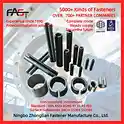

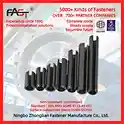


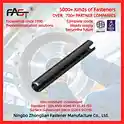
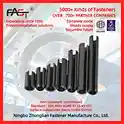
DIN 7344 Coiled Spring Pin | Heavy Type Marine Roll Pin
DIN 7344 Coiled Spring Pin | Heavy Type Marine Roll Pin
DIN 7344 / ISO 8751 | Diameter 1–13 mm | Carbon Steel C67S / SS304 / SS316 | Plain / Zinc Plated
DIN 7344 heavy type coiled spring pin (roll pin) for marine engine room shaft couplings, pump assemblies, gearbox dowel joints, and precision interference-fit applications requiring vibration-resistant retention.
Product Overview
TheDIN 7344 Coiled Spring Pin is a heavy-type roll pin manufactured by coiling a rectangular cross-section spring steel strip into a spiral form with chamfered entry ends. When driven into a reamed hole, the pin elastically compresses and exerts continuous radial pressure against the hole wall, creating a self-retaining interference fit that resists loosening under vibration and dynamic loading.
Unlike slotted spring pins (DIN 1481 / ISO 8752) which use a single longitudinal slot for compression, the DIN 7344 coiled spring pin features multiple spiral convolutions that distribute load more evenly, providing higher shear strength and superior fatigue resistance — critical for marine engine room rotating equipment.
Type Comparison: DIN 7344 vs DIN 1481
| Feature | DIN 7344 (Heavy Coiled) | DIN 1481 (Slotted) |
|---|---|---|
| Structure | Multi-layer spiral coil | Single slotted cylinder |
| Shear Strength | Higher (multi-wall thickness) | Lower (single wall) |
| Fatigue Resistance | Superior | Moderate |
| Hole Type | Reamed (precision) | Drilled or reamed |
| Marine Use | Shaft couplings, gearbox joints | General dowel, light-duty pins |
| ISO Equivalent | ISO 8751 | ISO 8752 |
Technical Specifications
| Parameter | Value |
|---|---|
| Standard | DIN 7344 (Heavy Type Coiled Spring Pin) |
| ISO Equivalent | ISO 8751 |
| Related Standard | DIN 7343 (Light Type) / ISO 8750 |
| Diameter Range | 1.0 mm – 13.0 mm |
| Length Range | 2.0 mm – 120.0 mm (standard); custom on request |
| Material | Carbon Steel C67S / C75S per DIN EN 10132-4; Stainless Steel SS302 / SS304 / SS316 |
| Hardness | 420–520 HV (Carbon Steel, hardened and tempered) |
| Surface Finish | Plain / Zinc Plated / Electroless Zinc-Nickel / Passivated (Stainless) |
| Entry End | Chamfered on both ends for easy insertion |
| Installation Hole | Reamed hole recommended (H7 tolerance) |
Dimensional Data (Selected Sizes)
| d (mm) | d₁ min (mm) | d₁ max (mm) | L (mm) | Shear Strength (kN) |
|---|---|---|---|---|
| 1.0 | 1.05 | 1.15 | 2–10 | 0.4 |
| 1.5 | 1.60 | 1.70 | 3–16 | 0.9 |
| 2.0 | 2.10 | 2.25 | 4–20 | 1.6 |
| 2.5 | 2.65 | 2.80 | 5–30 | 2.5 |
| 3.0 | 3.15 | 3.35 | 6–40 | 3.6 |
| 4.0 | 4.20 | 4.45 | 8–50 | 6.4 |
| 5.0 | 5.25 | 5.55 | 10–60 | 10.0 |
| 6.0 | 6.30 | 6.65 | 12–80 | 14.4 |
| 8.0 | 8.40 | 8.75 | 16–100 | 25.6 |
| 10.0 | 10.50 | 10.90 | 20–120 | 40.0 |
| 13.0 | 13.60 | 14.05 | 26–120 | 67.6 |
Note: d₁ = installed pin diameter (interference fit). Shear strength values are representative for carbon steel material. Contact us for full dimensional tables and material-specific shear data.
Marine Applications
- Shaft Couplings: Dowel pins for flexible and rigid coupling alignment in main propulsion and auxiliary drive systems
- Pump Assemblies: Impeller hub retention, bearing housing location pins in seawater cooling and bilge pumps
- Gearbox Joints: Precision dowel pins for gear train alignment and housing cover fastening
- Linkage Mechanisms: Pivot pins in valve actuator linkages, steering gear connections, and control rod joints
- Engine Mounting: Anti-vibration mount dowel pins for diesel engine bedplate alignment
Material & Finish Selection Guide
| Environment | Recommended Material | Recommended Finish |
|---|---|---|
| Indoor / Dry compartments | Carbon Steel C67S | Plain or Zinc Plated |
| Engine Room (moderate corrosion) | Carbon Steel C67S | Zinc-Nickel Electroless |
| Deck / Seawater exposure | SS316 | Passivated |
| Freshwater / General marine | SS304 | Passivated |
Installation Requirements
- Hole must be reamed to H7 tolerance for proper interference fit.
- Hole depth should exceed pin length by at least 1–2 mm to accommodate chamfered entry ends.
- Drive the pin in using a hammer or arbor press — do not use excessive force that could cause buckling.
- The chamfered ends guide the pin into the hole and reduce the risk of hole edge damage.
- For blind holes, ensure the hole depth allows the pin to sit flush or slightly below the surface.
- Do not reuse removed coiled spring pins — deformation during installation reduces radial retention force on re-use.
Why Choose SINOFASTENER
- Manufactured per DIN 7344 with uniform coiling tension and precise chamfer angles
- Full diameter range 1–13 mm with lengths from 2–120 mm, available from stock
- Carbon steel C67S hardened to 420–520 HV for consistent spring-back performance
- SS304 and SS316 stainless options for corrosive marine environments
- Annual production capacity 50,000 tons across all fastener categories
- Material certificates and dimensional inspection reports provided with every shipment
FAQ
What is the difference between DIN 7344 and DIN 1481?
DIN 7344 is a heavy-type coiled spring pin made from a multi-layer spiral coil, offering higher shear strength and fatigue resistance. DIN 1481 is a slotted spring pin with a single longitudinal slot, suitable for lighter-duty dowel applications. For marine engine room applications with vibration and dynamic loads, DIN 7344 is the preferred choice.
What is the ISO equivalent for DIN 7344?
The ISO equivalent for DIN 7344 is ISO 8751 (coiled spring pin, heavy type). Note that DIN 1481 corresponds to ISO 8752 (slotted spring pin) — these are different pin types and are not interchangeable.
Why is a reamed hole required for DIN 7344?
DIN 7344 coiled spring pins rely on precise interference fit for retention. A reamed hole (H7 tolerance) ensures consistent hole diameter, which directly controls the radial compression force and shear strength of the installed pin. Drilled holes with wider tolerances may result in inconsistent retention.
Can DIN 7344 coiled spring pins be used as locking pins?
Yes. DIN 7344 pins are commonly used as dowel pins for positional locking and alignment in shaft couplings, gearbox joints, and bearing housings. However, for applications requiring axial retention (preventing the pin from sliding out), a secondary method such as a circlip groove or threaded end may be needed.
What material is best for seawater exposure?
SS316 is recommended for direct seawater or splash zone applications. For engine room use where corrosion is moderate, carbon steel C67S with zinc-nickel plating provides sufficient protection at lower cost.
Contact Us
For DIN 7344 coiled spring pin inquiries, please contact:
E-mail:sales@sinofastener.com
SINOFASTENER — Marine Fastener Supplier | Annual Capacity 50,000 Tons