


Four Claw Nut (Pronged Insert Nut)
Four Claw Nut | Pronged Insert Marine Nut | SINOFASTENER
Four claw nut—pronged insert nut for ship cabin furniture, interior wall panel, and galley cabinet blind-side assembly. M4–M12 machine screw thread. Claw nut fastener in carbon steel zinc plated and 304 stainless steel. Four sharp prongs press into wood, MDF, or composite panel from the back face, creating a permanent threaded anchor without through-bolts. As a marine claw nut, the stainless version is specified for galley, washroom, and high-humidity zones on passenger vessels.
What Is a Four Claw Nut and How Does It Work?
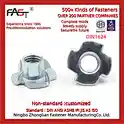
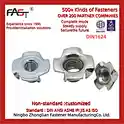
Afour claw nut is a pronged insert-type nut with four symmetrical sharp claws arranged on the base flange. It is installed by pressing or hammering into a pre-drilled hole from the back face of a wood panel, MDF board, or composite sheet. The four prongs bite into the substrate and lock permanently — then accept a machine screw from the front face, creating a clean threaded connection without any exposed fastener head on the visible side.
Thispronged insert nut design is widely used in ship interior outfitting where blind-side fastening is essential. Unlike a T-nut or barrel insert, the claw nut fastener requires no adhesives, no special tools beyond a hammer or arbor press, and no front-side access during installation. Each four claw nut functions as a durable, reusable threaded anchor — ideal for modular ship cabin furniture that must be disassembled and reassembled during refit cycles.
As a furniture claw nut, it replaces traditional wood screws in applications where repeated assembly and disassembly is required. The machine screw thread provides consistent engagement force, while the four-prong base prevents rotation within the substrate — a common failure mode of single-barrel inserts under vibration at sea.
Marine Applications
Note: The following applications are based on typical industry practice for four claw nut fasteners in marine interior outfitting and furniture assembly.
| Application | Typical Location | Recommended Material |
|---|---|---|
| Cabin wall panel mounting | Passenger cabin interior lining | Carbon steel zinc plated |
| Modular bunk bed frame | Crew cabin, vibration-prone | Carbon steel zinc plated |
| Galley cabinet assembly | Ship galley, cooking zone, high humidity | 304 stainless steel |
| Ceiling panel fastener | Accommodation deck ceiling | Carbon steel zinc plated |
| Washroom vanity unit | Passenger washroom, constant moisture | 304 stainless steel |
| Control room furniture | Bridge deck, instrumentation housing | Carbon steel zinc plated |
| Cruise ship lounge fit-out | Public area interior, high-traffic | 304 stainless steel |
Specifications & Materials
| Parameter | Range | Standard Reference |
|---|---|---|
| Product Type | Four Claw Nut (Pronged Insert Nut) | DIN 1624 type / GB/T 3510 |
| Thread Size | M4 to M12 (machine screw thread) | ISO 261 (metric coarse) |
| Prong Design | 4-claw symmetrical prongs for even embedment | DIN 1624 Form A |
| Material — Carbon Steel | Low carbon steel (DC01 / DC04), cold formed | EN 10130 |
| Material — Stainless Steel | AISI 304 (A2) for corrosion-prone zones | ISO 3506 |
| Surface Treatment — Carbon Steel | Zinc plated (clear / blue / white), nickel plated on request | ISO 2081 |
| Surface Treatment — Stainless Steel | Passivated (as-manufactured) | ASTM A967 |
| Minimum Panel Thickness | 12 mm (plywood, MDF, solid wood, composite) | Per installation practice |
| Pre-drilled Hole Diameter | Per DIN 1624 Table — matches prong outer diameter | DIN 1624 Table 2 |
| Installation Method | Hammer or arbor press from back face — no adhesive required | Standard workshop practice |
| Matching Fastener | Pan head / countersunk / hex machine screw | ISO 7045 / ISO 7046 / ISO 4014 |
Why Choose sinofastener for Marine Claw Nuts?
- Completefour claw nutrange: M4 to M12 in both carbon steel zinc plated and 304 stainless steel — covering all ship interior fastening requirements from standard cabin furniture to high-humidity galley and washroom zones.
- Claw nut fastener with precision-formed prongs:eachpronged insert nut is cold-formed from sheet stock with sharpened claw edges that bite into wood substrate on press-in, preventing rotation under machine screw torque and ship vibration.
- Marine claw nut in 304 stainless: for galley, washroom, and wet-area cabinetry where constant moisture demands corrosion resistance beyond standard zinc plated carbon steel. Passivated per ASTM A967 for maximum surface protection.
- Annual capacity 50,000 tons: full range furniture claw nutandfour claw nut from ready stock, packed in bulk boxes by size with moisture-barrier bags for stainless steel grades.
Standards Reference
- DIN 1624 — T-nuts with flat prongs for wood and wood-based materials (four-claw type)
- GB/T 3510 — Four claw nuts for furniture (Chinese national standard)
- ISO 261 — ISO general purpose metric screw threads (matching machine screw thread)
- ISO 7045 — Pan head cross recessed machine screws (matching fastener option)
- ISO 7046 — Countersunk flat head cross recessed machine screws (matching fastener option)
- ISO 4014 — Hex head bolts (matching fastener option)
- ISO 2081 — Zinc electroplated coatings on iron and steel (surface treatment reference)
- EN 10130 — Cold rolled low carbon steel flat products (material specification for carbon steel claw nuts)
- ASTM A967 — Chemical passivation treatments for stainless steel parts
FAQ
What is a four claw nut and how does it work?
Afour claw nut is a pronged insert nut with four sharp claws on the base flange. It is pressed into a pre-drilled hole from the back face of a wood panel or composite board. The prongs bite into the substrate and lock permanently, then accept a machine screw from the front face — creating a blind-side threaded connection with no exposed fastener head on the visible side. The claw nut fastener eliminates through-bolts and provides a clean finish for ship cabin interiors.
When to use stainless steel claw nut vs carbon steel?
Use a 304 stainless steel marine claw nut in high-humidity zones where moisture is constant — galley areas near cooking equipment, washroom vanity units, and outdoor-exposed panel connections. Use carbon steel zinc plated four claw nut for standard dry-area cabin furniture, wall panels, and ceiling connections in passenger accommodation. Stainless steel prevents rust staining on visible panel surfaces in wet zones where carbon steel zinc plating would eventually corrode.
What is the minimum panel thickness for four claw nut installation?
The minimum substrate thickness for reliable four claw nut installation is 12 mm — this applies to plywood, MDF, solid wood, and composite panels. Thinner panels (below 12 mm) risk the prongs penetrating through the opposite face or failing to achieve full embedment depth. For standard 16 mm and 18 mm ship cabin furniture panels, the pronged insert nut performs optimally with full prong engagement and no risk of breakthrough.
How does four claw nut compare to barrel insert and T-nut?
All three are threaded inserts for wood, but with different installation and performance characteristics. The four claw nut presses in with a hammer — no adhesive, no special tool — and the four prongs prevent rotation under vibration. Barrel inserts (threaded bushings) require adhesive bonding and a hex wrench for installation. Traditional T-nuts (per DIN 1624) use a flat prong base similar to the claw nut fastener but typically have 3–4 t-bar prongs without the sharpened bite edges. For ship cabin applications under continuous vibration, the four claw nut provides superior rotation resistance compared to adhesive-dependent barrel inserts.
Contact Us
Email: sales@sinofastener.com
Website: www.zlfastener.com | www.sinofastener.com (Main)