

Custom Foundation Anchor Bolt L J U Welded Plate Claw Base
Custom Foundation Anchor Bolt — L / J / U / Welded Plate / Claw Base
Foundation anchor bolts — also called foundation bolts,equipment baseplate bolts, or embedded anchor bolts — are heavy-duty fasteners cast or grouted into concrete foundations to permanently secure structural columns, machinery bases, and equipment pedestals. Unlike bolted connections that can be disassembled, foundation anchor bolts create a permanent structural link between the equipment and its foundation, transferring static and dynamic loads (vibration, tilting moment, wind, seismic) into the embedded concrete mass.
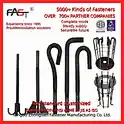
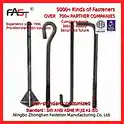
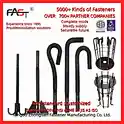
We manufacture all common forms — L-type,J-type,U-type,9-type(double-hook),welded plate base, and claw base — to suit different pullout load requirements and foundation geometries. All specifications are driven by customer-provided drawings; these are non-standard custom fasteners, not catalogue items.
Anchor Bolt Types — Function and Pullout Resistance
| Type | Geometry | Pullout Resistance | Typical Application |
|---|---|---|---|
| L-type | 90° bent leg at embedded end | Basic — relies on concrete cone failure resistance | Light-duty equipment base, column baseplate |
| J-type | J-shaped hook (180° return bend) | Moderate — hook engages larger concrete volume | Medium-duty machinery anchor, pump base |
| U-type | U-shaped with two legs embedded | High — dual anchor points double pullout capacity | Heavy equipment base, vibration-prone machinery |
| 9-type (Double-hook) | Two hooks at embedded end (9-shape) | Very high — mechanical interlock prevents concrete cone breakout | Crane rail foundation, high-uplift structural column |
| Welded Plate | Anchor plate welded to bolt end | Highest — plate bearing area transfers load directly into concrete | Offshore platform module base, heavy industrial pedestal |
| Claw Base | Multi-leg claw welded to end | Very high — claw legs spread load radially in concrete | Mooring bollard plinth, fairlead foundation |
Marine and Offshore Applications
In marine-adjacent heavy industrial settings, custom foundation anchor bolts are required for:
- Offshore platform topside modules: Each module is secured to the jacket or FPSO deck by dozens of foundation bolts sized for combined gravity, wave, and wind loading. Embedment depth and bolt diameter are engineered per load case — no two modules share the same specification.
- Shipyard gantry crane and winch baseplates: Crane rails require continuous anchor bolt rows with precise spacing tolerance (±2 mm). HDG carbon steel Grade 8.8 is standard for onshore shipyard applications.
- Mooring bollard and fairlead plinths: Bollards experience multi-directional pullout loads during vessel mooring. Claw-base or welded-plate anchors are specified to resist combined uplift and shear.
- Port terminal container crane rail foundations: Ship-to-shore crane rails span 30–50 m with anchor bolts at every sleeper. Fatigue resistance under cyclic wheel loads is a primary design criterion.
Material and Coating Selection
| Material | Tensile Strength | Environment | Typical Coating |
|---|---|---|---|
| Grade 4.8 Carbon Steel | 400 MPa | Indoor, non-corrosive | Zinc plated / HDG |
| Grade 8.8 Carbon Steel | 800 MPa | Onshore shipyard, port | HDG (hot-dip galvanized, 63 μm min per ISO 1461) |
| Grade 10.9 Carbon Steel | 1040 MPa | High-load structural | HDG / Dacromet / Geomet |
| A4-80 (316 SS) | 800 MPa | Seawater exposure, splash zone | Passivated (no coating required) |
| Duplex Stainless Steel (2205/2507) | 700–900 MPa | Offshore splash zone, subsea | Passivated (no coating required) |
Selection guide: For onshore shipyard and port crane foundations where HDG coating is intact, Grade 8.8 carbon steel is the cost-effective standard. For offshore platform splash-zone equipment bases where post-installation replacement is impractical, A4-80 or duplex stainless steel eliminates corrosion risk entirely. Thread forms include ISO metric, UNC, and custom pitch per client specification.
Manufacturing Process and Quality Control
- Raw material: Forged or hot-rolled bar stock, mill-tested to EN 10204 3.1 (standard) or 3.2 (with independent third-party witness).
- Forming: Embedded end formed by hot-bending (L, J, U, 9 types) or friction welding (plate and claw types). Bending performed at 900–1050 °C to avoid grain cracking.
- Thread rolling: Performed after bending/forming to ensure full thread strength is unaffected by heat treatment.
- Welding inspection: All plate and claw type welds undergo ultrasonic testing (UT) per EN ISO 17640 or magnetic particle inspection (MPI) per EN ISO 17638 — no weld defects accepted.
- Coating: HDG per ISO 1461 (minimum 63 μm for M12–M24, 75 μm for M24+). Stainless steel passivated per ASTM A967.
- Dimensional check: Each bolt verified for overall length, bend angle (±1°), thread gauge pass/go-no-go, and bolt circle positioning tolerance.
Product Specification
| Item | Detail |
|---|---|
| Product Name | Custom Foundation Anchor Bolt (L / J / U / 9-type / Welded Plate / Claw Base) |
| Standard | Non-standard, customized per customer drawing |
| Types | L-type / J-type / U-type / 9-type (double-hook) / Welded Plate Base / Claw Base |
| Diameter | M12 – M72 (1/2"– 3") |
| Length | Per drawing — up to 6 m single piece |
| Material — Carbon Steel | Grade 4.8 / 8.8 / 10.9 (per ISO 898-1) |
| Material — Stainless Steel | A2-70 / A4-80 / Duplex 2205 / 2507 |
| Thread | ISO Metric / UNC / UNF / Custom pitch |
| Surface Finish — Carbon Steel | HDG (per ISO 1461) / Zinc plated / Dacromet / Geomet |
| Surface Finish — SS | Passivated per ASTM A967 |
| Welding Inspection | UT (EN ISO 17640) / MPI (EN ISO 17638) for plate and claw types |
| Material Certification | EN 10204 3.1 (standard) / 3.2 (with third-party witness) |
| Packing | Thread-protected / Pallet / Custom labeling |
Complete Foundation Bolt Assembly Supply
We supply foundation bolts not as standalone items but as complete assembly kits per project requirements:
- Anchor bolts (L / J / U / 9 / plate / claw) — custom-manufactured per drawing
- Anchor plates / base plates — drilled to match bolt circle
- Leveling nuts and shims — for precise equipment elevation adjustment
- Grout sleeves — for post-installation grouting and corrosion protection of exposed thread
- Template jigs — steel positioning templates ensuring bolt circle accuracy during concrete pour
One-shipment delivery of the complete assembly eliminates on-site mismatch and reduces installation time.
FAQ
Q1: What is the difference between L-type and J-type anchor bolts?
A: L-type has a single 90° bend at the embedded end; J-type has a 180° return hook. The J-type hook engages a larger volume of concrete, providing higher pullout resistance than an L-type of the same diameter. L-type is simpler to manufacture and suits light-to-medium loads; J-type is preferred where uplift forces are significant.
Q2: Can you produce anchor bolts to our own drawing?
A: Yes. All our foundation anchor bolts are custom-manufactured per customer drawings. Send us the drawing with bolt dimensions, material grade, coating requirement, and quantity — we will confirm manufacturing feasibility, lead time, and pricing within 24–48 hours.
Q3: What is the maximum length you can produce?
A: Up to 6 meters as a single piece for diameters up to M48. For larger diameters or longer lengths, we can supply segmented bolts with welded couplers, subject to engineering review.
Q4: How do you ensure bolt circle positioning accuracy?
A: For each project, we supply a steel template jig (positioning template) drilled to match the exact bolt circle pattern. The template is placed on the formwork before concrete pour, and bolts are clamped into the template holes. After curing, the template is removed. Typical positioning tolerance: ±2 mm on bolt circle diameter.
Contact
Email:sales@sinofastener.com
Web:www.sinofastener.com
SINOFASTENER — Your Reliable Marine Fastener Partner