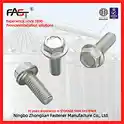


DIN933 Hex Bolt Full Thread ISO 4017
DIN 933 Hex Bolt — Full Thread Hex Head Bolt ISO 4017
TheDIN 933 hex bolt is a fully threaded hexagon head bolt manufactured to ISO 4017 dimensional standards. Unlike the partial-thread DIN 931 hex bolt (ISO 4014) which has an unthreaded grip length under the head, the DIN 933 full thread bolt carries metric coarse thread from directly beneath the bolt head to the tip — maximizing thread engagement in every millimeter of clamped material.
This full-thread configuration makes the DIN 933 hex bolt the preferred choice for three common joint conditions: thin-gauge flanges and plates where the entire bolt length passes through the clamped material; pre-tapped blind holes where the bolt screws directly into a threaded hole and full thread engagement is required for pullout strength; and variable clamp thickness assemblies where the exact grip length is unknown at the design stage, allowing the same bolt length to accommodate a range of material stack-ups.
DIN 933 vs DIN 931 — Full Thread vs Partial Thread
| Feature | DIN 933 (ISO 4017) | DIN 931 (ISO 4014) |
|---|---|---|
| Thread coverage | Full thread — head to tip | Partial thread — unthreaded grip length |
| Shear load capacity | Lower — shear acts on thread root | Higher — shear acts on full shank diameter |
| Blind hole suitability | Excellent — full engagement in tapped hole | Limited — unthreaded section does not engage |
| Thin flange / variable stack | Ideal — any grip length within bolt length | Must match grip to unthreaded length |
| Structural bolted joint | Less suitable | Preferred — unthreaded grip provides shear strength |
Marine Engine Room and Shipboard Applications
- Pump and compressor baseplate: Full-thread DIN 933 bolts secure machine feet to baseplate through-tapped holes. When baseplate thickness varies between pump models, the same bolt length accommodates the full range without separate part numbers.
- Heat exchanger shell flange: Blind-tapped bolt holes in the shell flange require full thread engagement for pressure-tight sealing. DIN 933 bolts provide maximum thread contact in the flange face.
- Generator mounting bracket: Brackets with multiple mounting hole depths benefit from full-thread bolts that adapt to any thickness within the bolt length.
- Instrument and control panel frame: Light-gauge sheet metal frames (2–5 mm) need bolts where thread starts immediately under the head — no unthreaded gap that leaves the thin sheet unsupported.
- Electrical conduit and cable tray support: Threaded rod hangers and strut channel connections use full-thread bolts to adjust height and clamp position continuously.
Material and Property Classes
| Grade | Material | Tensile Strength | Yield Strength | Marine Application |
|---|---|---|---|---|
| Grade 4.8 | Low/medium carbon steel | 400 MPa | 320 MPa | Non-structural, light fixture |
| Grade 8.8 | Medium carbon steel, quenched & tempered | 800 MPa | 640 MPa | General engine room machinery |
| Grade 10.9 | Alloy steel, quenched & tempered | 1040 MPa | 940 MPa | High-preload structural joint |
| A2-70 | AISI 304 stainless steel | 700 MPa | 450 MPa | Freshwater, indoor marine |
| A4-70 | AISI 316 stainless steel | 700 MPa | 450 MPa | Seawater, bilge, salt spray zone |
| A4-80 | AISI 316 cold-worked | 800 MPa | 600 MPa | High-strength marine, same corrosion resistance as A4-70 |
Selection note: Carbon steel grades (4.8/8.8/10.9) require protective coating for marine use. Stainless steel grades (A2/A4) provide inherent corrosion resistance without coating. For direct seawater or bilge exposure, A4-70 or A4-80 is mandatory.
Surface Finish Options
| Finish | Coating Thickness | Salt Spray Resistance | Application |
|---|---|---|---|
| Black oxide | ~1 μm | ~24 hours | Indoor machinery, non-reflective finish |
| Zinc plated (electro) | 5–8 μm | ~96 hours | Indoor, dry environment |
| HDG (hot-dip galvanized) | ≥ 63 μm (ISO 1461) | 500–1000+ hours | Outdoor, marine deck, exposed structure |
| Dacromet / Geomet | 6–8 μm | 720–1000+ hours | Engine room, high temp (up to 300 °C), no hydrogen embrittlement risk |
| Passivated (SS) | N/A (oxide film) | Material-dependent | All stainless steel grades, removes surface contamination |
Technical Standards
| Standard | Scope |
|---|---|
| DIN 933 | Hexagon head bolt, full thread — German national standard (withdrawn, superseded by ISO 4017, still widely referenced) |
| ISO 4017 | Hexagon head bolt, full thread — current international standard, dimensionally identical to DIN 933 |
| ISO 898-1 | Mechanical properties of fasteners — property classes 4.8, 8.8, 10.9 (carbon steel) |
| ISO 3506-1 | Mechanical properties of stainless steel fasteners — A2-70, A4-70, A4-80 |
| ISO 4759-1 | Tolerances for bolts, screws and studs — product grades A, B, C |
Product Specification
| Item | Detail |
|---|---|
| Product Name | DIN 933 Hex Bolt / Full Thread Hex Head Bolt |
| Standard | DIN 933 / ISO 4017 |
| Head Type | Hexagon head |
| Thread | Full thread, metric coarse (M4–M64) |
| Size Range | M4 – M64 |
| Length Range | 10 mm – 500 mm |
| Material — Carbon Steel | Grade 4.8 / 8.8 / 10.9 (per ISO 898-1) |
| Material — Stainless Steel | A2-70 / A4-70 / A4-80 (per ISO 3506-1) |
| Surface Finish | Black oxide / Zinc plated / HDG / Dacromet / Geomet / Passivated (SS) |
| Product Grade | Grade A (M4–M24) / Grade B (M24–M64) per ISO 4759-1 |
| Certification | EN 10204 3.1 material certificate; third-party inspection available |
| Packing | Carton + Pallet / Custom kit |
FAQ
Q1: What is the difference between DIN 933 and DIN 931?
A: DIN 933 (ISO 4017) is a full-thread bolt — thread runs from under the head to the tip. DIN 931 (ISO 4014) is a partial-thread bolt — it has an unthreaded grip length between the head and the start of thread. DIN 933 is used for thin plates, blind tapped holes, and variable stack-ups; DIN 931 is used for structural joints where shear loads act on the unthreaded shank.
Q2: Is DIN 933 still a valid standard?
A: DIN 933 was officially withdrawn and replaced by ISO 4017. However, the two standards are dimensionally identical — parts manufactured to ISO 4017 are fully interchangeable with parts ordered to DIN 933. Many marine and industrial specifications still reference DIN 933 by name. We manufacture to ISO 4017 as the active standard.
Q3: Can DIN 933 full-thread bolts be used in structural joints?
A: Full-thread bolts can be used in structural joints, but partial-thread bolts (DIN 931) are generally preferred because the unthreaded shank has a larger cross-section than the thread root, providing better shear resistance. If the joint is primarily tensile (no significant shear), full-thread DIN 933 bolts are acceptable.
Q4: What grade should I specify for marine engine room use?
A: For carbon steel in protected engine room compartments, Grade 8.8 with Dacromet or Geomet coating is the standard choice — good strength, no hydrogen embrittlement risk, and high-temperature resistance. For compartments with direct seawater exposure or bilge splash, use A4-70 or A4-80 stainless steel.
Contact
Email:sales@sinofastener.com
Web:www.sinofastener.com
SINOFASTENER — Your Reliable Marine Fastener Partner