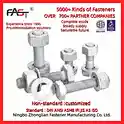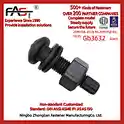


Ship Construction Fasteners — Hull & Deck Structural Bolts
Ship Construction Fasteners — Structural Bolts for Hull, Bulkhead and Deck Assembly
Ship construction fasteners are the structural bolting components used throughout every stage of vessel assembly — from hull block erection and bulkhead joining to deck equipment mounting and superstructure fabrication. These fasteners must withstand continuous wave-induced stress, saltwater corrosion, and the vibration loads inherent in steel-hulled vessels. SINOFASTENER manufactures a complete range of marine construction bolts per ISO 4014/4017, DIN 931/933, and ASTM A325/A490 standards, covering Grade 8.8 and 10.9 high-strength structural bolts in M12–M64 sizes for shipyard new construction and repair projects.
Every batch of hull structure fasteners is produced with full material traceability and EN 10204 3.1 mill certificates. Hot-dip galvanized finishes per ISO 1461 provide 70 μm minimum coating thickness for above-deck and ballast tank zones, while A4-70/A4-80 (316) stainless steel ship construction bolts are specified for submerged and splash-zone connections where galvanic corrosion is a primary concern.
What Are Ship Construction Fasteners?
Ship construction fasteners encompass the high-strength bolts, nuts, washers, and associated shipment. Coating certification and test reports included with each batch.
Hydrogen Embrittlement Control: For Grade 10.9 bolts, documented pre-galvanizing bake (200°C ≥4h) and post-galvanizing bake (200°C ≥24h) procedures per ISO 10684 Annex B prevent delayed fracture in high-strength structural connections.
Annual Capacity 50,000 Tons: Integrated manufacturer with forging, heat treatment, thread rolling, and galvanizing in-house. EN 14399 and EN 15048 certified for structural bolting assemblies, with full EN 10204 3.1 traceability.
Standards Reference
| Standard | Scope |
|---|---|
| ISO 4014 | Hexagon head bolts — product grades A and B, partial thread |
| ISO 4017 | Hexagon head bolts — product grades A and B, full thread |
| ISO 898-1 | Mechanical properties of fasteners — carbon and alloy steel bolts |
| ISO 898-2 | Mechanical properties of fasteners — nuts with specified proof load values |
| ISO 1461 | Hot-dip galvanized coatings on iron and steel articles |
| ISO 10684 | Fasteners — hot-dip galvanized coatings (Annex B: hydrogen embrittlement relief) |
| ISO 9227 | Salt spray corrosion testing (NSS method) |
| EN 14399 | High-strength structural bolting assemblies for preloading |
| EN 15048 | Non-preloaded structural bolting assemblies |
| ASTM A325 | Structural bolts, steel, heat treated, 120/105 ksi minimum tensile |
| SOLAS II-1 | Construction — structure, subdivision and stability, machinery |
| IMO PSPC | Performance standard for protective coatings (ballast tanks) |
| EN 10204 | Types of inspection documents for metallic products (3.1 MTC) |
FAQ
Q1: What grade of bolt is used for ship hull construction?
Grade 8.8 and Grade 10.9 bolts per ISO 898-1 are the standard property classes for ship hull construction. Grade 8.8 (800 MPa UTS, 640 MPa yield) is used for general structural connections such as bulkhead stiffeners and deck plate joints. Grade 10.9 (1040 MPa UTS, 940 MPa yield) is specified for high-load connections including hull block erection joints, main engine foundations, and deck equipment mounting. Per IACS UR S26 for structural bolting, property class and surface treatment must be documented with material certificates.
Q2: Why is hot-dip galvanizing required for ship construction fasteners?
Ship construction fasteners are exposed to saltwater splash, high humidity in ballast tanks, and marine atmospheric corrosion. Hot-dip galvanizing per ISO 1461 provides a minimum local coating thickness of 70 μm (85 μm average for M16+), which typically achieves 1000+ hours of salt spray resistance per ISO 9227. The zinc coating provides both barrier protection and cathodic protection to the underlying steel — if the coating is scratched, the zinc corrodes preferentially, protecting the exposed steel. Per IMO PSPC requirements for ballast tank coatings, the galvanizing system must be compatible with the tank's overall protective coating scheme.
Q3: What is the difference between ISO 4014 and ISO 4017 structural bolts?
ISO 4014 specifies hexagon head bolts with partial thread — a smooth shank (grip length) exists between the bolt head and the threaded portion. This unthreaded section is critical for structural shear connections, as it provides a larger bearing diameter and eliminates the stress concentration that a thread root creates in the shear plane. ISO 4017 specifies full-thread hexagon bolts, where the thread runs the entire shank length. Full-thread bolts are used where grip length varies or where the connection is primarily in tension. For ship hull construction, ISO 4014 (partial thread) is preferred for primary structural connections, while ISO 4017 is used for equipment mounting and secondary connections.
Q4: Does SINOFASTENER provide EN 10204 3.1 certificates with ship construction fasteners?
Yes. Every batch of ship construction fasteners is supplied with EN 10204 3.1 material test reports, including chemical composition (heat analysis), mechanical properties (tensile strength, yield strength, elongation, hardness), coating thickness measurements, and dimensional inspection results. Third-party inspection by SGS, BV, TUV, or classification society surveyors (ABS, DNV, LR, BV, CCS) can be arranged upon request. Products conform to classification society requirements but are not supplied with class certification unless specified at the time of order.
Contact Us
Email: sales@sinofastener.com | bobo@sinofastener.com
Tel: 0574-86592068
Website: www.zlfastener.com | www.sinofastener.com (Main)