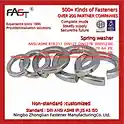

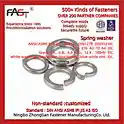
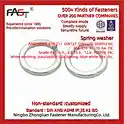
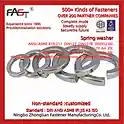
DIN 127 Spring Washer (Split Ring Lock Washer)
DIN 127 Spring Washer | Marine Lock Washer | SINOFASTENER
DIN 127 spring washer—split ring spring washer for marine vibration resistance and anti-loosening in bolted connections. M3–M48, carbon steel spring washer (hardened C60–C75 spring steel) and stainless steel spring washer (A2-70 / A4-70). Paired with DIN 125 flat washer for complete marine spring washer locking systems on hull frame, engine mount, and deck machinery bolts.
What Is DIN 127 Spring Washer and How Does It Work?
ADIN 127 spring washer is a split ring-shaped washer with a helical twist that creates an elastic preload force when compressed under a bolt head or nut. The split edges bite into the mating surfaces during installation, generating frictional resistance that prevents the fastener from rotating loose under vibration.
Thissplit ring spring washer design is the most widely used anti-vibration locking method in marine and industrial fastening. During assembly, the washer is compressed flat by the clamping force, storing elastic energy that maintains continuous axial pressure on the joint. The inclined cut edges create a one-way ratchet effect — they grip tightly against loosening rotation but allow free turning during tightening.
As a marine spring washer, the DIN 127 is used in every shipboard area subject to vibration — engine room machinery mounts, hull frame bolts, pipe flange connections, deck equipment foundations, and steering gear assemblies. Unlike prevailing-torque lock nuts, the spring washer does not alter the bolt or nut thread geometry, so it can be reused if undamaged and does not require special assembly torque procedures.
Marine Applications
Note: The following applications are based on typical industry practice for DIN 127 spring washers in marine vibration-prone connections.
| Application | Typical Service | Recommended Material |
|---|---|---|
| Engine mount bolt | Engine room, continuous vibration | Carbon steel hardened, HDG or Dacromet |
| Hull frame connection bolt | Hull structure, vibration + salt spray | Carbon steel HDG |
| Pipe flange bolt | Engine room / deck, vibration + pressure | A4-70 (316 SS) / Dacromet |
| Deck machinery foundation | Exposed deck, vibration + weathering | Carbon steel HDG |
| Propulsion system mount | Engine room, high vibration + heat | Carbon steel hardened, Dacromet |
| Seawater pump coupling | Engine room bilge, corrosion + vibration | A4-70 (316 SS) |
| Ventilation duct flange | Engine room / accommodation, vibration | Carbon steel zinc plated |
Specifications & Materials
| Parameter | Range | Standard Reference |
|---|---|---|
| Product Type | Split Ring Spring Washer (Lock Washer) | DIN 127 / DIN 127B |
| Size Range | M3 to M48 (matches bolt nominal diameter) | DIN 127 Table 1 |
| Material — Carbon Steel | Spring steel C60 / C67 / C75 / 65Mn, hardened and tempered | DIN 127 / EN 10270-1 |
| Material — Stainless Steel | A2-70 (304 SS) / A4-70 (316 SS) | ISO 3506 |
| Hardness — Carbon Steel | 42–50 HRC (after hardening and tempering) | DIN 127 Section 5 |
| Surface Treatment — Carbon Steel | HDG / Zinc plated / Dacromet / Plain (oiled) | Per purchaser specification |
| Surface Treatment — Stainless Steel | Passivated (pickled and passivated) | ASTM A967 |
| Type A | Rectangular cross section with angled cut ends (standard) | DIN 127 Form A |
| Type B | Square cross section with square cut ends | DIN 127 Form B / DIN 127B |
| Matching Flat Washer | DIN 125 / ISO 7089 (placed between spring washer and nut) | DIN 125 / ISO 7089 |
Why Choose sinofastener for Marine Spring Washers?
- CompleteDIN 127 spring washerrange: M3 to M48 in all material grades — carbon steel hardened, A2-70, and A4-70 stainless — with full hardness verification (42–50 HRC for carbon steel per DIN 127 requirements).
- Marine spring washer matched systems:eachsplit ring spring washer supplied with matching DIN 125 flat washer in the same material and finish, ready for direct installation without additional procurement.
- Stainless steel spring washer for critical corrosion zones: A4-70 (316) stainless DIN 127 spring washer for seawater splash zones, submerged connections, and chemical exposure areas — passivated per ASTM A967 for maximum corrosion resistance.
- Annual capacity 50,000 tons: full range of carbon steel spring washer and stainless options from ready stock, with mill test certificates and hardness reports on every batch.
Standards Reference
- DIN 127 — Spring washers, rectangular cross section (Form A) and square cross section (Form B / DIN 127B)
- DIN 128A / DIN 128B — Heavy-duty spring washers (for high-load structural connections)
- GB/T 93 — Standard spring lock washer (Chinese national standard equivalent to DIN 127 Form A)
- GB/T 94.1 — Spring lock washers (Chinese national standard equivalent to DIN 127)
- DIN 125 — Flat washers, Class A (matching flat washer for spring washer installation)
- ISO 7089 — Plain washers, normal series, product grade A (ISO equivalent of DIN 125)
- EN 10270-1 — Patenting cold drawn steel wire (material standard for carbon steel spring washers)
- ASTM A967 — Standard Specification for Chemical Passivation Treatments for Stainless Steel Parts
FAQ
What is DIN 127 spring washer and how does it prevent loosening?
TheDIN 127 spring washer is a split ring washer with a helical shape that stores elastic energy when compressed under a bolt head or nut. It prevents loosening through two mechanisms: (1) continuous axial spring force that maintains clamping pressure, and (2) the sharp cut edges that bite into the mating surfaces, creating a one-way friction lock against loosening rotation. This split ring spring washer design is the most common anti-vibration method in marine and industrial bolted connections.
When should I use stainless steel spring washer instead of carbon steel?
Use a stainless steel spring washer (A4-70 / 316) when the connection is exposed to seawater, salt spray, chemical agents, or high humidity — typical locations include waterline-level pipe flanges, bilge area pump mounts, and deck hardware in splash zones. Use a carbon steel spring washer (hardened C60–C75 with HDG or Dacromet) for engine room dry areas and above-waterline structural connections where cost optimization is needed. Never mix carbon steel washers with stainless bolts in corrosion-prone areas — galvanic corrosion will damage the carbon steel washer first.
What is the difference between DIN 127 and DIN 128 spring washers?
Both are DIN 127 spring washer type products, but DIN 128 is the heavy-duty variant. DIN 127 (standard) has a rectangular or square cross section suitable for general-purpose bolted connections up to M48. DIN 128 has a thicker cross section with higher spring force, designed for heavy-load structural connections in shipbuilding and steel construction. For most marine spring washer applications — engine mounts, hull bolts, pipe flanges — DIN 127 is sufficient. DIN 128 is reserved for high-stress joints such as heavy crane foundations and main engine bearing caps.
How to correctly install spring washer with flat washer?
The correct assembly order from the workpiece outward is: bolt head → flat washer (DIN 125) → workpiece → flat washer (DIN 125) → split ring spring washer (DIN 127) → nut. The flat washer protects the workpiece surface and distributes the clamping force. The spring washer sits between the flat washer and the nut face, with its sharp edges facing the flat washer and nut. The cut ends of the DIN 127 spring washer should be oriented so they dig into the surfaces during tightening (not during loosening). Never place the spring washer directly against a painted or soft surface — always use a flat washer to prevent surface damage.
Contact Us
Email: sales@sinofastener.com
Website: www.zlfastener.com | www.sinofastener.com (Main)