

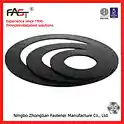

Rubber Flange Gasket (NBR/EPDM/FKM) for Marine Piping per ASME B16.21
ASME B16.21 nonmetallic flat gaskets are the standard sealing solution for bolted pipe flange connections in marine piping systems. These gaskets are dimensionally compatible with flanges manufactured per ASME B16.5 (NPS 1/2 to NPS 24) and ASME B16.47 (NPS 26 to NPS 60), covering the full range of pipe sizes found in marine engine room, ballast, cooling, and fire-fighting piping systems.
We supply rubber flange gaskets in three primary elastomer materials — NBR(Nitrile),EPDM, and FKM (Fluoroelastomer) — each selected for specific fluid media, temperature ranges, and chemical environments encountered in marine service. Gaskets are available in both Inside Bolt Circle (IBC / Ring)andFull Face configurations, with pressure ratings from PN10 to PN40 (Class 150 to Class 300).
Available Materials and Properties
Each elastomer material serves a distinct range of marine applications. The following data is based on standard industrial grades per ASTM D2000 classification system:
| Property | NBR (Nitrile) | EPDM | FKM (Viton) |
|---|---|---|---|
| Density (g/cm3) | 1.40 - 1.70 | 1.06 - 1.20 | 1.80 - 2.00 |
| Hardness (Shore A) | 60 - 75 | 50 - 65 | 70 - 80 |
| Tensile Strength (MPa) | 5 - 14 | 7 - 9 | 9 - 12 |
| Elongation at Break | 200% - 400% | 300% - 500% | 200% - 340% |
| Continuous Service Temp. | -20 to +70 C | -40 to +130 C | -10 to +200 C |
| Oil Resistance | Excellent | Poor | Excellent |
| Seawater / Freshwater | Moderate | Excellent | Good |
| Ozone / UV Resistance | Poor | Excellent | Excellent |
| Chemical Resistance (acids/bases) | Poor | Good | Excellent |
| ASTM D2000 Typical Class. | Type BG / BF | Type CA / DA | Type HK |
Data: ASTM D2000-18 rubber classification system; heco.de elastomer technical data sheet; asiangaskets.com NBR/EPDM/FKM specifications.
Material Selection Guide for Marine Service
NBR (Nitrile Rubber) — Default choice for sealing against petroleum-based fluids, hydraulic oil, fuel oil, and lubricating oil in marine engine rooms. Not suitable for ozone exposure or outdoor weathering without protection.
EPDM — Preferred for ballast water systems, cooling water circuits, fire-fighting pipelines, and freshwater services. Outstanding resistance to seawater, steam, and weathering. Not compatible with mineral oils or petroleum-based media.
FKM (Fluoroelastomer / Viton) — High-performance option for chemical tankers, high-temperature fuel lines, and aggressive media environments. Excellent resistance to oils, fuels, acids, and temperatures up to 200 C continuous service.
Material selection criteria per ASTM D2000-18 and ISO 1629 rubber nomenclature standard.
Dimensions and Standards
Gasket dimensions follow ASME B16.21-2021, which defines Outside Diameter (O.D.) and Inside Diameter (I.D.) for each NPS size to match mating flanges per ASME B16.5 (Class 150/300) and ASME B16.47. The standard also covers thickness tolerance and marking requirements.
IBC (Inside Bolt Circle / Ring) Gasket Dimensions — ASME B16.5 Class 150 (Selected Sizes):
| NPS | DN | Gasket I.D. (in) | Gasket O.D. (in) | Bolt Count | Bolt Dia. (in) |
|---|---|---|---|---|---|
| 2 | 50 | 2.38 | 4.12 | 4 | 3/4 |
| 4 | 100 | 4.50 | 6.88 | 8 | 3/4 |
| 6 | 150 | 6.62 | 8.75 | 8 | 3/4 |
| 8 | 200 | 8.62 | 11.00 | 8 | 7/8 |
| 10 | 250 | 10.62 | 13.12 | 12 | 7/8 |
| 12 | 300 | 12.75 | 15.25 | 12 | 1.00 |
| 16 | 400 | 16.00 | 20.25 | 16 | 1.13 |
| 20 | 500 | 20.00 | 23.88 | 20 | 1.25 |
| 24 | 600 | 24.00 | 28.25 | 20 | 1.38 |
Dimensions per ASME B16.21-2021, Table based on Garlock ASME B16.21 gasket dimension chart for Class 150 flanges.
Full-face gasket dimensions extend the ring O.D. to the flange bolt circle and include bolt holes for matching the flange bolt pattern. Both IBC and full-face types are available across all standard sizes.
Pressure and Temperature Ratings
| Pressure Class | PN Rating | Applicable Standard | Max. Bolt Circle Pressure |
|---|---|---|---|
| Class 125 | PN6 | ASME B16.1 / ASME B16.21 | 6 bar (87 psi) |
| Class 150 | PN10 / PN16 | ASME B16.5 / ASME B16.21 | 10-16 bar (145-232 psi) |
| Class 300 | PN25 / PN40 | ASME B16.5 / ASME B16.21 | 25-40 bar (363-580 psi) |
Pressure ratings per ASME B16.5-2020 and ASME B16.21-2021. Note: Elastomer gaskets are suitable for low to moderate inner pressures; pressure-temperature limits depend on elastomer material selection per heco.de technical specifications.
Standard thickness options: 1.5 mm, 3.0 mm, 4.5 mm, 6.0 mm. Custom thicknesses are available per project requirements.
Marine Applications
Rubber flange gaskets are used throughout marine piping systems across all vessel types, including cargo ships, tankers, bulk carriers, offshore platforms, and naval vessels. Typical applications include:
- Ballast water piping — EPDM gaskets resist seawater corrosion and biofouling; widely used in Class 150 flanged connections throughout the ballast system.
- Cooling water circuits — Central cooling, jacket water, and heat exchanger flanges require resilient gaskets that maintain seal under thermal cycling; EPDM or NBR per media type.
- Fire-fighting water lines — Full-face EPDM gaskets ensure positive sealing in emergency systems where reliability is critical.
- Fuel oil and lube oil piping — NBR gaskets resist petroleum-based fluids in engine room fuel transfer, day tank, and lubrication systems.
- Chemical cargo lines — FKM gaskets handle aggressive chemical media on chemical tankers and offshore supply vessels.
- Compressed air and control air lines — General-purpose NBR or EPDM gaskets for instrument air and service air piping.
Quality and Testing
All gaskets are manufactured and tested in accordance with the following standards:
| Standard | Scope |
|---|---|
| ASME B16.21-2021 | Dimensions, tolerances, materials, and marking for nonmetallic flat gaskets |
| ASTM D2000-18 | Rubber material classification by heat resistance (Type) and oil resistance (Class) |
| ASTM D2240 | Shore A hardness testing method for rubber materials |
| ASTM D412 | Tensile strength and elongation testing for vulcanized rubber |
| ASTM D395 | Compression set testing — critical for long-term static seal performance |
| ISO 1629 | Rubber nomenclature — standardizes polymer designations (NBR, EPDM, FKM, etc.) |
Standards referenced: ASTM D2000-18 (astm.org), ASME B16.21-2021 (asme.org), ISO 1629 rubber nomenclature.
Material certificates and test reports are provided upon request. Third-party inspection (class surveyor) can be arranged for specific orders.
FAQ
Q: What is the difference between IBC and Full Face gaskets?
A: IBC (Inside Bolt Circle) gaskets fit inside the bolt pattern and are used with raised-face flanges. Full Face gaskets extend to the bolt circle and include bolt holes, used with flat-face flanges. ASME B16.21 defines dimensions for both types.
Q: Can rubber gaskets be used for high-temperature marine steam lines?
A: EPDM can handle saturated steam up to approximately 130 C continuously. For higher steam temperatures, consider compressed fiber gaskets or spiral wound gaskets instead. FKM is rated to 200 C but is not recommended for saturated steam service due to hydrolysis risk.
Q: What size range do you supply?
A: We supply from DN15 (1/2") to DN600 (24") as standard, covering all ASME B16.5 Class 150 and Class 300 flange sizes. Larger sizes per ASME B16.47 are available on request.
Q: How do I specify material for a marine order?
A: Provide the service media (water, oil, fuel, chemical), operating temperature range, and flange standard (ASME B16.5 Class). We will recommend the appropriate elastomer per ASTM D2000 classification and confirm the gasket dimensions match your flange specification.


