

DIN982 Nylon Insert Lock Nut | ISO 7040 Nyloc Nut Heavy Type
DIN982 Nylon Insert Lock Nut | ISO 7040 Nyloc Nut Heavy Type
Standards: DIN 982 / ISO 7040 | Size: M5 - M36 | Grades: 5 / 8 / 10 / A2-70 / A4-80
Surface: Plain (stainless) / Zinc Plated / Dacromet / Geomet
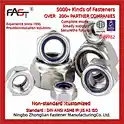
The DIN982 heavy type nylon insert lock nut (ISO 7040) is a prevailing torque self-locking nut with a permanently embedded nylon collar at the top of the thread. As the nut is tightened onto a mating bolt, the undersized nylon ring deforms elastically against the bolt thread flanks, generating friction-based prevailing torque that resists loosening under vibration, dynamic load, and mechanical shock — without requiring spring washers, lock washers, or secondary locking devices.
The heavy type designation means the DIN982 nut body is taller than the standard DIN985 thin type, providing greater nylon thread engagement and higher prevailing torque. This makes it the preferred lock nut for high-vibration marine assemblies where joint integrity is critical.
Marine Applications
- Deck Equipment: Winch base mounting, cleat backing plate fasteners, fairlead brackets, capstan anchor bolts — where wave-induced vibration and shock loading continuously threaten standard nut joints
- Engine Room Machinery: Pump motor mounts, compressor isolation brackets, generator foot bolts, auxiliary machinery foundations — areas of sustained mechanical vibration
- Piping Systems: Cable tray support brackets, instrument tubing clamps, small-bore pipe hangers where vibration fatigue causes conventional nuts to back off
- Mooring and Anchoring: Bollard fasteners, chain stopper mounting, davit cradle bolts — safety-critical joints that must maintain preload in heavy weather
Locking Mechanism: Prevailing Torque
Unlike standard hex nuts that rely solely on preload friction, DIN982 nylon insert lock nuts generate prevailing torque independent of clamp force. The total tightening torque equation becomes: T(total) = T(thread) + T(bearing) + T(prevailing), where prevailing torque originates from the nylon insert deformation. This means the nut maintains locking resistance even when clamp load fluctuates.
Per ISO 2320, prevailing torque must remain within defined minimum and maximum limits:
| Size | Prevailing Torque Min (Nm) | Prevailing Torque Max (Nm) |
|---|---|---|
| M5 | 0.18 | 0.80 |
| M6 | 0.28 | 1.20 |
| M8 | 0.60 | 2.40 |
| M10 | 1.10 | 4.20 |
| M12 | 1.70 | 6.80 |
| M16 | 3.50 | 14.0 |
| M20 | 6.00 | 24.0 |
| M24 | 9.50 | 38.0 |
Prevailing torque values per ISO 2320, measured on first assembly. Re-usability: maximum 5 cycles; verify prevailing torque remains within limits after each re-use. For safety-critical marine applications (lifting gear, structural joints), single use is recommended.
DIN982 Heavy Type vs DIN985 Thin Type
| Feature | DIN982 / ISO 7040 (Heavy Type) | DIN985 / ISO 10511 (Thin Type) |
|---|---|---|
| Nut Height (M8 example) | 9.5 mm | 8.0 mm |
| Nylon Thread Engagement | Greater (taller body) | Less (lower profile) |
| Prevailing Torque | Higher | Lower |
| Application | High-vibration, heavy-duty marine | Light-duty, space-restricted |
| Stock Availability | Less common — made to order for many sizes | Dominant stock item worldwide |
Key Dimensions (DIN982 / ISO 7040)
| Thread | Pitch P (mm) | WAF s (mm) | Height h max (mm) | Thread Zone m min (mm) |
|---|---|---|---|---|
| M5 | 0.8 | 8 | 6.3 | 4.4 |
| M6 | 1.0 | 10 | 8.0 | 4.9 |
| M8 | 1.25 | 13 | 9.5 | 6.44 |
| M10 | 1.5 | 17 | 11.5 | 8.04 |
| M12 | 1.75 | 19 | 14.0 | 10.37 |
| M16 | 2.0 | 24 | 18.0 | 14.1 |
| M20 | 2.5 | 30 | 22.0 | 16.9 |
| M24 | 3.0 | 36 | 28.0 | 20.2 |
| M30 | 3.5 | 46 | 34.0 | 25.6 |
| M36 | 4.0 | 55 | 40.0 | 31.0 |
Dimensions per DIN 982 / ISO 7040. Thread tolerance 6H per ISO 965. Nylon insert temperature limit: -50 to +120 C. For applications exceeding 120 C, all-metal prevailing torque nuts (ISO 7042 / DIN 6925) are recommended.
Important Design Notes
- One-way installation: DIN982 nylon insert lock nuts must be installed with the nylon insert facing up (away from the work surface). Installing upside down eliminates the locking effect.
- Re-use limit: Maximum 5 assembly cycles per ISO 2320. The nylon insert deforms progressively with each cycle, reducing prevailing torque. For lifting gear, structural joints, and safety-critical marine applications, replace after single use.
- Temperature ceiling: Standard nylon (PA6/PA66) inserts are rated to +120 C. Above this temperature the insert softens and loses prevailing torque. For engine room applications with sustained temperatures above 100 C, specify all-metal prevailing torque nuts instead.
- Torque calculation: When calculating tightening torque for a bolted joint with DIN982 lock nuts, add prevailing torque to the standard thread and bearing friction torque. Do not ignore the prevailing torque component in critical joints.
Specifications
| Product Name | DIN982 Nylon Insert Lock Nut (Heavy Type) / ISO 7040 Nyloc Nut |
| Standard | DIN 982 / ISO 7040 |
| Type | Prevailing Torque Lock Nut with Non-Metallic Nylon Insert (Heavy/High Type) |
| Size Range | M5 - M36 |
| Thread Class | 6H per ISO 965 |
| Material / Grade | Carbon Steel Class 5 / 8 / 10; SS304 A2-70; SS316 A4-80 |
| Surface Finish | Plain (stainless) / Zinc Plated / Dacromet / Geomet |
| Nylon Insert Temperature | -50 to +120 C (PA6/PA66) |
| Prevailing Torque Test | Per ISO 2320 |
| Certification | EN 10204 3.1 Material Certificate; ISO 9001 Quality System; Third-party inspection available upon request |
| Related Standards | DIN 985 / ISO 10511 (thin type); ISO 7042 / DIN 6925 (all-metal prevailing torque) |
| Annual Capacity | 50,000 tons |
Contact
SINOFASTENER - Marine fastener supplier, M5-M36 DIN982 nylon insert lock nuts in full carbon steel and stainless steel grades with EN 10204 3.1 material traceability. Annual capacity 50,000 tons. We supply complete material certificates and can cooperate with third-party inspection per classification society requirements.
Email:sales@sinofastener.com
Website: www.zlfastener.com | www.sinofastener.com