
Preload Loss in Bolted Joints: Marine Causes & Prevention Guide | SINOFASTENER

Preload Loss in Ship Hull Bolted Joints: Causes and Prevention
A bolted joint on a ship hull carries enormous responsibility. It holds structural plates together under constant vibration, saltwater exposure, and thermal stress. When the initial clamping force drops below the design threshold, the entire connection weakens. This phenomenon — preload loss in bolted joints — is one of the most common causes of structural failure in marine engineering.
Understanding why preload drops, how to detect it early, and what prevention methods actually work can save shipyards and operators from costly repairs, downtime, or catastrophic failures. This guide covers the four main causes and the solutions that work in real marine conditions.
What Bolt Preload Actually Means for Ship Hull Integrity
Before addressing preload loss in bolted joints, it helps to understand what preload does. When a marine bolt is tightened to the specified torque, the bolt stretches slightly. This elastic stretch creates a clamping force that presses the connected plates together. That clamping force is the preload.
The preload does far more than hold parts together. It creates friction between the contact surfaces. This friction resists shear forces, prevents plate movement, and stops the bolt from rotating loose. Without adequate preload, the bolt itself must absorb every external load directly.
In ship hull structures, the consequences are especially severe. Hull plates experience continuous dynamic loads from wave impacts, engine vibration, and cargo movement. A joint that loses preload transfers these loads directly to the bolt shank. Over time, this leads to fatigue cracking, thread stripping, or sudden fracture.
Therefore, maintaining the correct bolt preload throughout the service life of a marine connection is not optional. It is essential for structural safety.
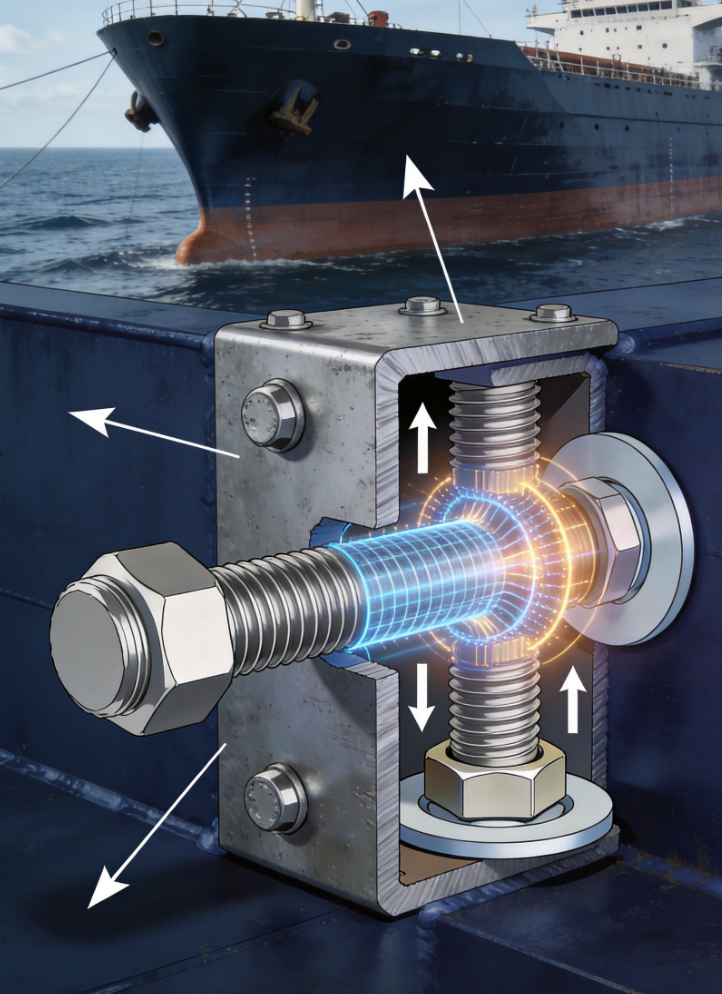
Vibration-Induced Loosening: The Primary Cause of Preload Loss in Marine Environments
Among all causes, vibration-induced loosening accounts for the largest share of preload loss in bolted joints on ships. Marine vessels generate vibration from multiple sources: main engines, propellers, hull resonance, and wave slamming. Each vibration cycle creates tiny relative movements between the bolt threads and the clamped surfaces.
These micro-movements gradually rotate the nut or bolt head. Engineers call this "transverse slip." Once slip begins, the preload drops rapidly — often within just a few hundred vibration cycles. Studies show that transverse vibration loosens bolts far faster than axial vibration.
Several factors accelerate vibration loosening on ships:
- Engine proximity: Bolts near main engines or generators experience higher vibration amplitudes.
- Hull resonance: Certain hull sections amplify vibration at specific frequencies.
- Insufficient friction: Poor surface preparation or wrong friction coefficient assumptions reduce joint resistance to slip.
- Incorrect preload: Under-tightened joints are more vulnerable because lower clamping force means less friction to resist rotation.
As a result, ship hull bolts in high-vibration zones require specific anti-loosening measures — not just higher torque values.
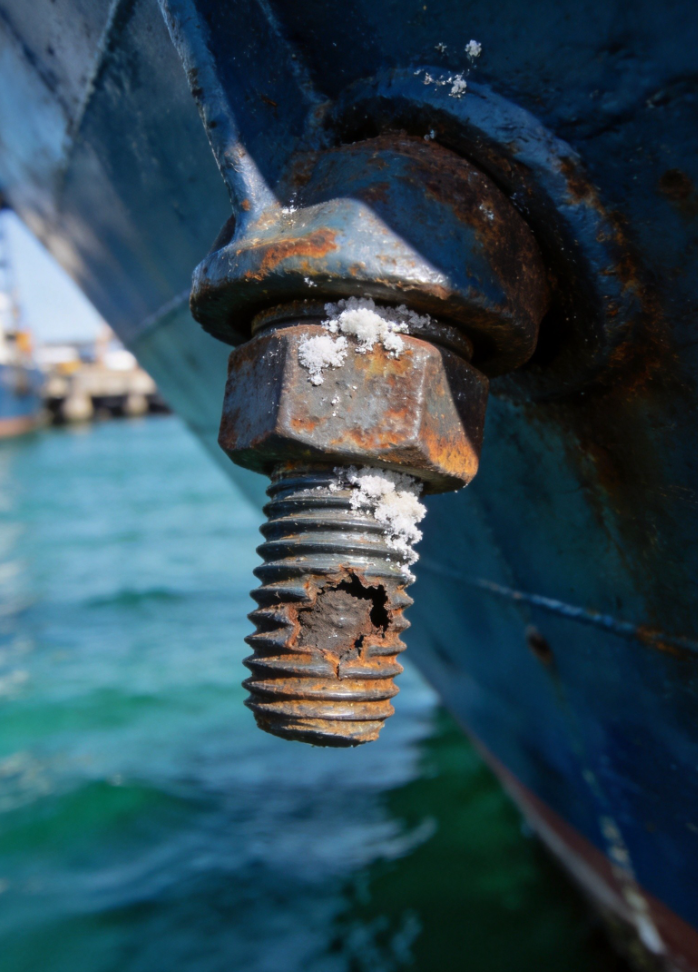
Corrosion: The Silent Cause of Preload Loss in Marine Bolted Joints
The marine environment attacks fasteners on multiple fronts. Saltwater spray, high humidity, and chemical exposure all accelerate corrosion. When bolt threads corrode, the effective cross-section shrinks. This means the same torque produces less actual preload because friction has increased dramatically on the corroded surfaces.
Corrosion causes preload loss in bolted joints through three mechanisms:
- Thread corrosion: Rust buildup on threads increases friction during tightening. The torque reading may look correct, but the actual bolt stretch is far below target.
- Stress corrosion cracking (SCC): High-strength marine fasteners under tension are susceptible to hydrogen embrittlement and chloride-induced cracking. The bolt can fail suddenly without warning.
- Galvanic corrosion: When dissimilar metals contact in saltwater, the anodic material corrodes rapidly. A carbon steel bolt in a stainless steel plate, for example, will degrade quickly.
Furthermore, corrosion products occupy more volume than the original metal. This expansion can create apparent tightening at first. However, as corrosion continues, the material loss reduces the effective preload. Therefore, corrosion protection is not just about appearance — it directly maintains joint integrity.
Embedding and Relaxation: Why New Joints Lose Preload Over Time
Even a perfectly installed joint loses some preload during the first hours and days after assembly. Engineers call this "embedding" or "relaxation." It happens because surface irregularities on the clamped plates and bolt head gradually flatten under pressure.
This settling effect reduces the bolt stretch slightly. Consequently, the clamping force drops. For most standard joints, embedding loss ranges from 5% to 15% of the initial preload. However, in marine bolted connections with multiple interfaces or coated surfaces, the loss can be higher.
Several factors increase embedding loss in ship applications:
- Coated surfaces: Paint, epoxy, or zinc coatings compress under load. Thicker coatings cause more embedding.
- Rough surfaces: Unmachined steel plates have higher surface peaks that flatten during initial loading.
- Multiple joint interfaces: Joints with three or more plates stacked together have more surfaces that can settle.
- Gasket materials: Soft gaskets or sealing compounds compress significantly under bolt load.
Because of this effect, many marine specifications require re-torquing after 24 to 48 hours. This practice recovers the preload lost to embedding and ensures the joint reaches the design clamping force.
Thermal Cycling and Its Impact on Marine Bolt Preload
Ships operate across wide temperature ranges. Engine room bolts face high temperatures, while deck bolts face cold seawater and wind. When temperature changes, the bolt and clamped materials expand or contract at different rates. This differential expansion creates additional stress or reduces the existing preload.
In ship hull structures, thermal cycling occurs constantly: day-night temperature swings, warm-to-cold voyage transitions, and proximity to hot engine components. Over thousands of cycles, these thermal effects contribute to gradual preload loss in bolted joints.
Specifically, two thermal mechanisms are at work:
- Differential expansion: If the bolt material has a higher thermal expansion coefficient than the clamped plates, heating stretches the bolt further. Cooling then relaxes it. Repeated cycling gradually reduces average preload.
- Thermal relaxation: High-strength bolts at elevated temperatures experience creep — slow plastic deformation under constant strain. This permanently reduces bolt length and preload.
For marine structural bolts operating near engine exhausts or steam lines, thermal effects become a primary design consideration. In these cases, standard torque-based installation may not be sufficient. Instead, engineers may specify tensioning methods that account for operating temperature.
How to Detect and Monitor Preload Loss
Detecting preload loss early prevents failures. Several methods work in marine environments:
- Torque check: Using a calibrated torque wrench to measure the "breakaway" torque of a fastener. This provides an indirect estimate of current preload. However, friction variations affect accuracy.
- Ultrasonic measurement: Measuring bolt length with an ultrasonic transducer. Since preload correlates directly with bolt stretch, length measurement gives the most accurate preload reading. This method works well for critical marine connections.
- Load-indicating washers: Special washers with visual or electronic indicators show whether preload remains above a threshold. These provide ongoing monitoring without removing the bolt.
- Mark inspection: Simple visual check using torque-mark lines drawn across the nut and bolt. If the marks no longer align, the fastener has rotated and lost preload.
For routine maintenance on ship hull bolts, the mark inspection method offers the best balance of speed and reliability. Therefore, many ship operators include torque-mark checks in their regular marine fastener inspection schedules.
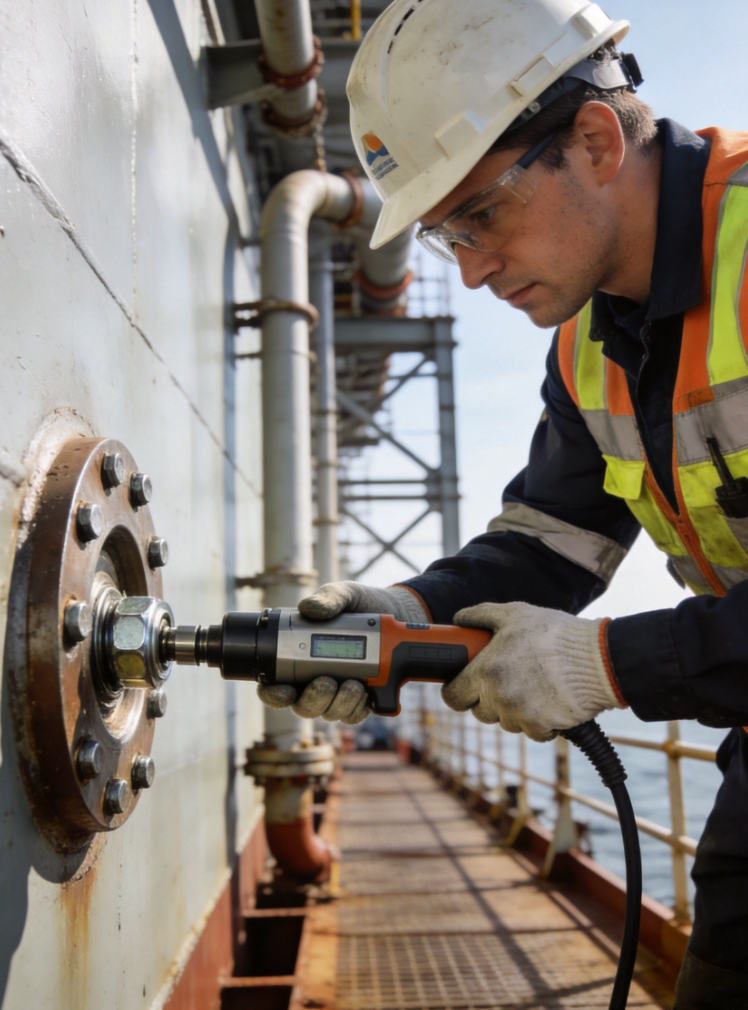
Prevention Strategies: Keeping Bolt Preload Stable at Sea
Preventing preload loss in bolted joints requires addressing the specific causes present in your application. Here are proven strategies for marine environments:
- Use anti-loosening fasteners: Nord-Lock washers, prevailing-torque nuts, or chemical thread lockers resist vibration-induced rotation. For ship hull bolts in high-vibration zones, these are essential.
- Apply proper corrosion protection: Hot-dip galvanized, PTFE-coated, or stainless steel fasteners resist marine corrosion. However, verify that the coating type matches the application — some coatings increase embedding loss.
- Follow re-torque procedures: Re-torque critical joints after 24–48 hours and at regular intervals per the maintenance schedule. This recovers embedding and relaxation losses before they compound.
- Control friction with lubrication: Proper lubrication during installation ensures consistent torque-to-preload conversion. Unlubricated or contaminated threads produce unpredictable preload regardless of torque accuracy.
- Specify correct torque values: Torque specifications must account for thread condition, lubrication state, coating type, and target preload. Generic torque tables often produce inadequate clamping in marine applications.
- Implement preload monitoring: For critical structural connections, install load-indicating washers or schedule regular ultrasonic measurements. Early detection allows maintenance before failure occurs.
Moreover, proper installation technique matters as much as the fastener quality. Clean threads, correct alignment, and controlled tightening speed all contribute to achieving the target preload consistently.
Key Takeaways for Marine Engineers and Ship Operators
- Preload loss in bolted joints is the leading cause of marine connection failures. Vibration, corrosion, embedding, and thermal cycling are the four main causes.
- Vibration-induced transverse slip loosens bolts faster than any other mechanism in high-vibration ship zones.
- Corrosion increases thread friction and reduces effective cross-section, both of which reduce actual preload below the torque-indicated value.
- Embedding and relaxation losses are normal but can be recovered through re-torquing after initial installation.
- Thermal cycling near engine areas requires special consideration in bolt material selection and tightening method.
- Regular preload monitoring — through torque checks, ultrasonic measurement, or load-indicating washers — catches problems before they become failures.
With over 35 years of fastener supply experience and ISO 9001:2015 certification, Zhonglian Fastener (SINOFASTENER) supplies marine structural bolts and fastener assemblies engineered for demanding marine environments. Our 50,000-ton annual capacity covers M12–M64 in full range of international standards including ASTM, DIN, EN, and ISO.
Frequently Asked Questions
What is the main cause of preload loss in ship hull bolted joints?
Vibration-induced transverse slip is the primary cause. Engine vibration, propeller imbalance, and wave impacts create cyclic loading that gradually rotates the nut, reducing clamping force. Corrosion ranks as the second most common cause in marine environments.
How often should marine bolt preload be inspected?
Critical structural bolts should be checked within 24–48 hours after initial installation to recover embedding losses. After that, routine inspections every 3–6 months are typical for high-vibration zones. For low-stress areas, annual checks may be sufficient. Always follow the vessel's maintenance schedule.
Can lubrication prevent preload loss in bolted joints?
Lubrication does not prevent preload loss directly, but it ensures consistent torque-to-preload conversion during installation. Properly lubricated threads achieve the target preload more accurately. For preventing loss after installation, anti-loosening washers or prevailing-torque nuts are more effective.
Which bolt materials resist marine preload loss best?
Austenitic stainless steel (A4/316) offers excellent corrosion resistance and maintains preload well in wet environments. High-strength alloy steel fasteners with proper coatings — such as PTFE or hot-dip galvanized — also perform well. The key is matching the material to the specific marine exposure conditions.
What is the difference between torque control and tension control for marine bolts?
Torque control applies a specific rotational force to achieve target preload. It is affected by friction variations. Tension control measures the actual bolt stretch directly, providing more accurate preload regardless of friction. For critical ship hull connections, tension control methods like hydraulic tensioning are preferred.
Contact Us
Brand Site: www.zlfastener.com
Corporate: www.sinofastener.com
📧 Email: sales@sinofastener.com
☎️ Tel: 0086-574-86592087 | 0086-574-86592094 | 0086-574-86592026 | 0086-574-86592096
Salt Spray Test Hours: 48/72/240/720h and What They Really Mean | sinofastener
Correct Bolt Tightening Sequence for Ship Pipe Flange Connections


