
Correct Bolt Tightening Sequence for Ship Pipe Flange Connections

In marine engineering, proper flange connection is critical for maintaining piping systems integrity across all vessel operations. The flange bolts used in shipboard applications face unique challenges: constant vibration, thermal cycling, saltwater exposure, and strict safety regulations. This guide focuses on the essential bolt tightening sequence that ensures reliable, leak-free connections throughout the service life of your marine infrastructure.
Why Tightening Sequence Matters in Ship Piping
When structural bolts are tightened incorrectly, the consequences extend beyond simple flange leakage. Uneven loading creates differential stresses across the joint, leading to gasket compression failures and potential pressure boundary breaches.
Ship piping systems operate under demanding conditions that make proper bolt preload particularly critical:
- Ballast water system pipes experience constant fill-drain cycles with temperature variations
- Fuel oil pipeline flanges must maintain zero-leak integrity for safety compliance
- Cooling water circuit connections face thermal expansion stresses during operations
The bolted joint integrity depends not just on torque value, but equally on how that torque is applied across the flange bolts.
The Star Pattern: Industry Standard for Flange Connections
Per ASME PCC-1 guidelines, the star pattern tightening method is the preferred approach for circular flange bolts. This technique distributes gasket compression uniformly by tightening opposite bolt pairs in sequence.
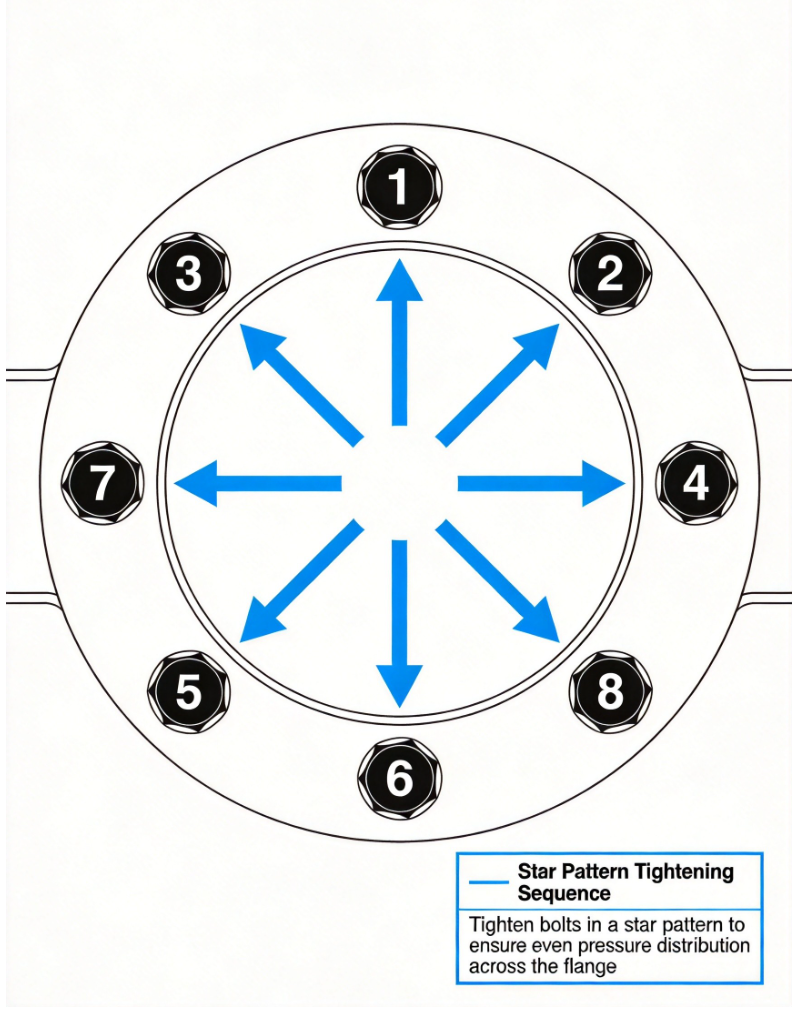
For an 8-bolt flange configuration (common in shipbuilding applications), the sequence follows:
- Tighten bolt positions 1-5 (opposite pairs)
- Proceed to bolt positions 3-7
- Complete with bolt positions 2-6 and 4-8
This radial approach prevents flange rotation and ensures the gasket compression remains even around the entire joint circumference.
Multi-Stage Torque Control Method
The torque control procedure specified in EN 1591-4 recommends progressive tightening in percentage stages:
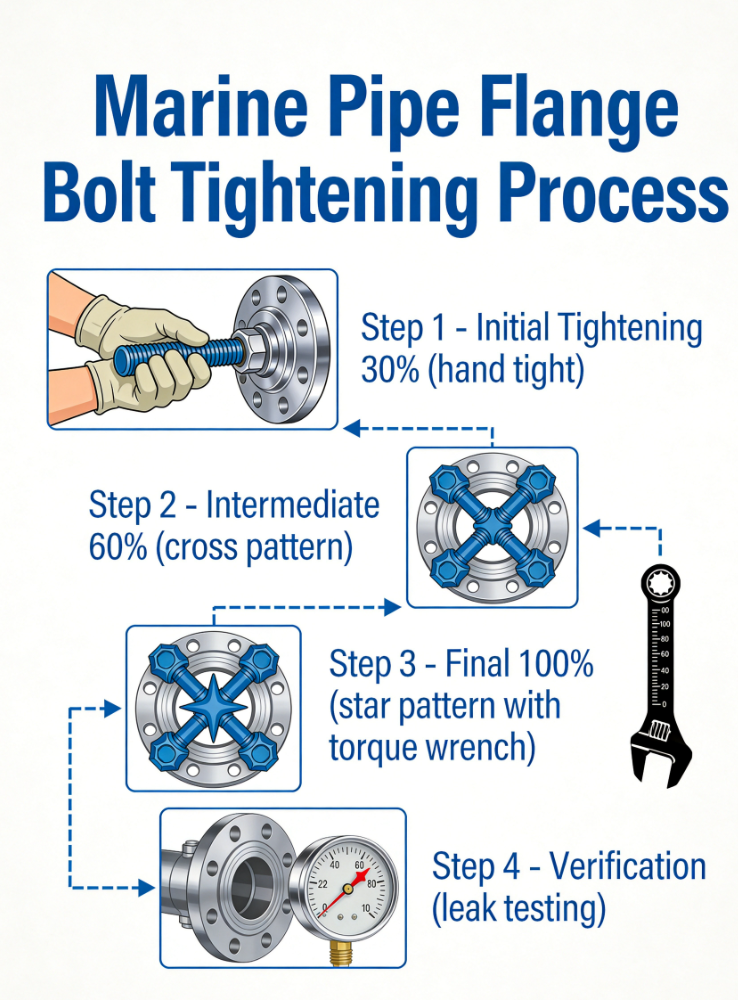
Stage 1: Initial Contact (30%)
Hand-tighten all stud bolts to ensure the gasket seats properly. This stage focuses on alignment, not load.
Stage 2: Intermediate Load (60%)
Apply torque control to approximately 60% of target using the star pattern. Monitor flange face gap for uniform closure.
Stage 3: Final Torque (100%)
Complete the bolt tightening sequence to full specified torque, maintaining the star pattern throughout.
Stage 4: Verification
Perform leak testing per ASME B16.5 requirements to confirm flange leakage integrity before system commissioning.
Critical Errors to Avoid in Marine Applications
High-strength fasteners used in shipboard piping systems demand precise handling. Common mistakes include:
- Tightening in sequential order instead of star pattern—creates uneven gasket compression
- Skipping torque stages—risks bolted joint integrity failure
- Using incorrect bolt preload values for ASTM A193 grade stud bolts
- Neglecting retorque after thermal cycling in fuel oil pipeline systems
Per EN 14399 standards, high-strength fasteners for marine applications require documented installation procedures and verification records.
Ship-Specific Considerations for Flange Assembly
Shipbuilding projects demand attention to application-specific factors:
Ballast Water System
Connections must withstand treatment system pressure variations. Use marine fasteners with enhanced corrosion resistance for ballast water system applications.
Fuel Oil Pipeline
Safety-critical joints require torque control meeting ASME PCC-1 fugitive emission guidelines. Document all flange bolts installation parameters.
Cooling Water Circuit
Thermal cycling necessitates consideration of joint relaxation. Factor in appropriate bolt preload loss compensation per EN 1591-4.
All marine fasteners should meet ASME B16.5 dimensional standards and ASTM A193 material specifications for reliable pressure boundary performance.
Standards Reference for Marine Flange Connections
| Standard | Application |
|---|---|
| ASME PCC-1 | Bolt tightening sequence and torque control |
| ASME B16.5 | Pipe flanges and flange fittings |
| EN 1591-4 | Bolted flange joints with metallic gaskets |
| EN 14399 | High-strength structural bolting assemblies |
| ASTM A193 | Alloy-steel and stainless steel bolting materials |
Conclusion
Proper flange bolt tightening sequence implementation ensures reliable piping systems performance in demanding marine environments. The star pattern approach combined with multi-stage torque control delivers consistent gasket compression and maintains bolted joint integrity throughout vessel service life.
For marine fasteners meeting EN 14399 and EN 15048 certifications, partner with experienced suppliers who understand shipbuilding requirements.
Contact Us
Brand Site: www.zlfastener.com
Corporate: www.sinofastener.com
Email: sales@sinofastener.com
Tel: 0086-574-86592087 | 0086-574-86592094 | 0086-574-86592026 | 0086-574-86592096
Preload Loss in Bolted Joints: Marine Causes & Prevention Guide | SINOFASTENER
Ship Classification Fastener Standards: ABS, DNV, LR & IACS Requirements Explained


