
Deck Equipment Fastener Corrosion in Marine Salt Spray: Material Selection and Protection Methods
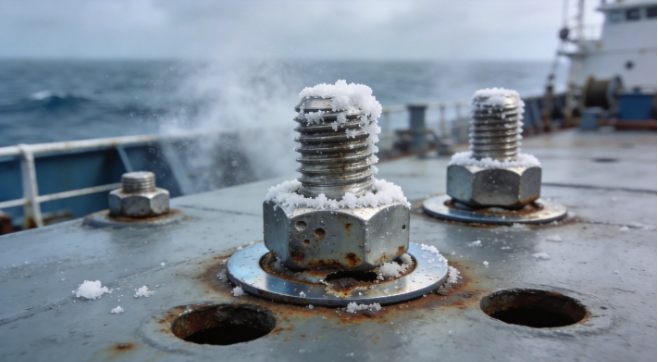
Deck Equipment Fastener Corrosion in Marine Salt Spray: Material Selection and Protection Methods
How to prevent premature fastener failure on ship decks caused by salt spray corrosion. A practical guide covering corrosion mechanisms, material selection per ISO 9223, coating systems per ISO 12944, and maintenance inspection intervals for deck hardware fasteners.
Fastener corrosion on ship deck equipment is one of the most common causes of premature joint failure in marine environments. Unlike below-deck locations where temperature and humidity are relatively controlled, deck fasteners are continuously exposed to salt spray, UV radiation, thermal cycling, and mechanical vibration from engine operation and wave impact.
This article explains the corrosion mechanisms that attack deck equipment fasteners, how to select the right material and coating for each deck zone based on ISO 9223 corrosivity classification, and which protection methods deliver the longest service life per ISO 12944.
Corrosion Mechanisms Affecting Deck Equipment Fasteners
Ship deck fasteners are subjected to multiple simultaneous corrosion mechanisms. Understanding which mechanism dominates at each deck location is the first step to selecting the right material and coating.
| Deck Zone | Corrosion Mechanism | ISO 9223 Category | Risk Level |
|---|---|---|---|
| Foredeck (exposed) | Salt spray deposition + UV degradation + mechanical abrasion | CX (Extreme) | Very high |
| Main deck (cargo area) | Continuous salt spray + chemical exposure from cargo residue | C5-M (Very high marine) | High |
| Afterdeck / stern | Salt spray + propeller wash aerosol + vibration from propulsion | C5-M (Very high marine) | High |
| Superstructure | Salt spray + crevice corrosion under fittings + galvanic coupling | C4 (High) | Moderate to high |
| Upper deck (sheltered) | Intermittent salt spray + condensation + UV | C3 (Medium) | Moderate |
The three most destructive mechanisms for marine salt spray corrosion on deck fasteners are:
1. Chloride-induced pitting corrosion. Chloride ions from seawater penetrate the passive oxide layer on stainless steel fasteners, creating localized pits that propagate rapidly. A4 stainless steel (AISI 316) with a PREN value above 25 resists pitting significantly better than A2 (AISI 304, PREN ~18), but even A4 can pit in stagnant saltwater deposits under washers and bolt heads.
2. Crevice corrosion on deck fasteners. The gap between a bolt head and washer, or between a nut and clamped surface, traps saltwater and creates an oxygen-depleted zone. This oxygen concentration cell accelerates anodic dissolution inside the crevice. Crevice corrosion on deck fasteners is especially severe under flat washers, lock washers, and where two dissimilar metal surfaces contact.
3. Galvanic corrosion. When a stainless steel bolt is installed through an aluminum deck plate or a carbon steel bracket, a galvanic cell forms in the presence of saltwater electrolyte. The less noble metal (aluminum or carbon steel) corrodes preferentially. Nylon washers or insulating sleeves are required to break the galvanic circuit.
Material Selection for Deck Equipment Fasteners
Selecting the correct fastener material for each deck zone requires balancing corrosion resistance, mechanical strength, and cost. The following table compares the four most common material choices for deck equipment fastener corrosion prevention:
| Material | Standard | PREN Value | Yield Strength (MPa) | Salt Spray Resistance (ASTM B117) | Best Deck Zone |
|---|---|---|---|---|---|
| A4-80 Stainless Steel (AISI 316) | ISO 3506-1 | 25 - 32 | 600 | Excellent up to 1000+ hours | Foredeck, main deck, cargo area |
| A2-70 Stainless Steel (AISI 304) | ISO 3506-1 | 17 - 20 | 450 | Fair, pitting after 200-400 hours | Upper deck, sheltered areas only |
| HDG Carbon Steel Class 8.8 | ISO 898-1 + ISO 10683 | N/A (coated) | 640 | Good up to 500 hours, depends on coating thickness | General deck equipment, non-critical |
| ASTM A193 B7 + Coating | ASTM A193 | N/A (coated) | 725 | Depends on coating system applied | High-temperature deck piping flanges |
For C5-M and CX zones (foredeck, main deck, cargo area), A4-80 stainless steel is the minimum recommended material. A2-70 should only be used in C3 or lower zones. For high-strength structural connections where A4-80 yield strength is insufficient, duplex stainless steel (UNS S31803, PREN > 32) or hot-dip galvanized high-strength bolts with supplementary coating are the alternatives.
Coating Systems for Carbon Steel Deck Fasteners
When stainless steel is not practical due to strength requirements or cost, hot-dip galvanized fasteners with supplementary coating systems provide effective protection. Per ISO 12944-5, the following coating systems are recommended for marine deck environments:
| Coating System | ISO 12944-5 Reference | Dry Film Thickness | Expected Life (C5-M) | Application |
|---|---|---|---|---|
| Hot-dip galvanizing + epoxy seal coat | System 5.4.3 | 80 - 120 µm | 10 - 15 years | Heavy structural deck connections |
| Zinc flake coating per ISO 10683 | ISO 10683 Class C | 5 - 8 µm | 5 - 8 years | Preloaded high-strength bolt assemblies |
| Zinc-rich primer + polyurethane topcoat | System 5.4.5 | 120 - 160 µm | 10 - 15 years | Large flanges and custom assemblies |
| Mechanical zinc plating per ASTM B695 | ASTM B695 Class 50 | 12 - 25 µm | 3 - 5 years | Small fasteners, instrument mounting |
Hot-dip galvanized fasteners per ASTM A153 or ISO 10683 remain the most widely used protection method for carbon steel deck fasteners. However, in C5-M environments, bare hot-dip galvanizing alone provides insufficient life. A seal coat or supplementary paint system per ISO 12944 is necessary to extend service intervals.
For preloaded structural bolt assemblies (Class 10.9 and above), zinc flake coating per ISO 10683 is preferred over hot-dip galvanizing because it avoids hydrogen embrittlement risk and provides a consistent friction coefficient for torque-controlled tightening.
Design Measures to Reduce Deck Fastener Corrosion
Beyond material and coating selection, several design practices significantly reduce deck equipment fastener corrosion rates:
Avoid crevice traps. Use domed cap nuts (acorn nuts) instead of standard hex nuts where possible. Cap nuts eliminate the exposed thread end that traps saltwater. Where hex nuts are unavoidable, apply a marine-grade sealant (polysulfide or polyurethane) around the nut after final tightening.
Break galvanic circuits. Install nylon washers (PA66) or insulating sleeves between dissimilar metal contact surfaces. For a stainless steel bolt through an aluminum deck plate, use both a nylon washer under the bolt head and a nylon sleeve through the hole to achieve full galvanic isolation.
Provide drainage. Design deck equipment mounting so that saltwater cannot pool around fastener heads. Horizontal bolt heads that collect rain and seawater spray corrode significantly faster than vertically oriented bolts where water drains freely.
Specify correct gasket materials. Non-metallic gaskets (EPDM, neoprene) between deck equipment and the deck plate prevent direct metal-to-metal contact and reduce both galvanic and crevice corrosion risk at the fastener interface.
Maintenance Inspection Intervals for Deck Fasteners
Even with correct material selection and coating, marine salt spray corrosion is a progressive process. Regular inspection is essential to detect early signs of corrosion before structural integrity is compromised.
| Inspection Level | Frequency | Scope | Action Criteria |
|---|---|---|---|
| Visual check | Monthly | Surface rust staining, white corrosion product on zinc coatings | Clean and touch-up coating if rust bleed-through detected |
| Detailed inspection | Quarterly | Crevice areas under washers, nut faces, thread exposure | Replace fastener if pitting depth exceeds 10% of nominal diameter |
| Torque verification | Annually | Preloaded structural connections, crane and winch mounting bolts | Retorque if loss exceeds 15% of specified value; replace if corrosion is present on threads |
| Overhaul | Dry-docking (every 2.5 - 5 years) | Complete fastener replacement in C5-M and CX zones | Replace all fasteners showing any sign of active corrosion, regardless of remaining section |
Frequently Asked Questions
304 stainless steel (A2-70) has a PREN value of approximately 18, which provides good corrosion resistance in atmospheric conditions but is insufficient for continuous salt spray exposure. Chloride ions in seawater break down the passive oxide layer on 304 stainless steel, causing pitting corrosion typically within 200 to 400 hours of continuous salt spray (ASTM B117 test). For deck equipment, always specify A4-80 (AISI 316, PREN > 25) or higher.
Hot-dip galvanized fasteners per ISO 10683 provide adequate protection for marine deck applications in C3 and C4 zones (sheltered areas, superstructure). However, in C5-M and CX zones (foredeck, main deck, cargo area), bare hot-dip galvanizing alone will corrode through within 3 to 5 years. For these zones, either use A4-80 stainless steel or apply a supplementary seal coat per ISO 12944-5 to extend service life to 10-15 years.
Visual inspection should be performed monthly, with detailed inspection quarterly. Preloaded structural connections (crane pedestals, winch foundations) require annual torque verification. During dry-docking, all fasteners in C5-M and CX zones showing any active corrosion should be replaced regardless of remaining cross-section. These intervals align with IMO/flag state maintenance requirements for cargo area equipment.
C5 is a high corrosivity category for industrial environments with aggressive chemical atmosphere. C5-M is the marine equivalent, specifically defined for offshore and coastal environments with continuous salt spray exposure. The testing requirements for C5-M are more stringent: coating systems must pass 4200 hours of neutral salt spray testing (ASTM B117) with less than specified评级 of rusting. For ship deck fastener coatings, always reference C5-M rather than C5.
About sinofastener
sinofastener is a professional marine fastener supplier based in Ningbo, China, with full EN 14399 and EN 15048 certification for structural bolting. We supply A2-70, A4-80 and duplex stainless steel fasteners, hot-dip galvanized high strength bolts, and complete coating systems per ISO 12944 for marine deck equipment, hull structure and engine room applications.
Annual production capacity: 50,000 tons. Size range: M12 to M64. All materials supplied with EN 10204 3.1 certificates. Third party inspection by DNV, ABS, LR, CCS, SGS available.
For deck equipment fastener inquiries:
Email: sales@sinofastener.com | bobo@sinofastener.com
Tel: 0574-86592068
Website: www.zlfastener.com | www.sinofastener.com (Main)
Hatch Cover Bolt Failure Modes and Maintenance Guide
Galvanic Corrosion in Marine Fastener Joints: Mechanisms, Risks, and Prevention


