
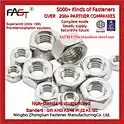

ASTM F594 Stainless Steel Nut | Marine Hexagon Nut
ASTM F594 Marine Stainless Steel Nut
ASTM F594 stainless steel nutsformarine pipingandflange connections. Manufactured in 304 (Condition CW), 316 (Condition TF), and 316L (Condition H)perASTM F594 standard. Available in sizes M6 to M48 (1/4"to 2") with hex, heavy hex, and jam nut configurations. All products supplied with EN 10204 3.1 material certificates and full chemical composition traceability. Products comply with marine classification society requirements and are available for third-party inspection (DNV, ABS, LR, CCS).
What Is an ASTM F594 Marine Stainless Steel Nut?
AnASTM F594 marine stainless steel nut is a corrosion-resistant fastener specifically designed for use in marine piping systemsandflange connections aboard vessels. The ASTM F594 specification covers seven alloy groups of stainless steel nuts, with Groups 304 (CW), 316 (TF), and 316L (H) being the most commonly used in marine environments due to their excellent resistance to seawater corrosion and pitting.
316 stainless steel is the preferred choice for marine piping applications because of its molybdenum content (2-3%), which significantly improves resistance to chloride pitting corrosion — a critical factor in seawater service. 316L (low carbon variant) is used when welding is involved in the piping assembly, as it minimizes carbide precipitation at weld zones. 304 stainless steel is suitable for less aggressive environments such as freshwater systems and interior deck fittings.
Marine Applications
Note: The following applications are based on typical industry practice for ASTM F594 stainless steel nuts in marine piping and flange environments. Specific material selection should be confirmed with the vessel's classification society requirements.
| Application | Recommended Grade | Service Condition |
|---|---|---|
| Ballast water system flanges | 316 (Condition TF) | Seawater exposure |
| Cooling water circuit connections | 316L (Condition H) | Welded piping joints |
| Fuel oil pipeline flanges | 316 (Condition TF) | Hydrocarbon + moisture |
| Freshwater piping | 304 (Condition CW) | Non-chloride service |
| Deck machinery flanges | 304 / 316 | Atmospheric corrosion |
Specifications & Materials
| Parameter | Range | Standard Reference |
|---|---|---|
| Standard | ASTM F594 | ASTM F594 |
| Nut Types | Hex Nut, Heavy Hex Nut, Jam Nut | ASTM F594 Table 1 |
| Size Range | M6 – M48 (1/4"– 2") | ASTM F594 |
| Thread | Metric / UNC / UNF | ASME B1.13M, ASME B1.1 |
| Material Grades | 304 (CW), 316 (TF), 316L (H) | ASTM F594 Alloy Groups |
| Min Tensile Strength | 304 CW: 860 MPa; 316 TF: 760 MPa; 316L H: 690 MPa | ASTM F594 Table 2 |
| Finish | Passivated, Pickled, Bright Annealed | per industry practice |
| Inspection | EN 10204 3.1 Certificate; Third-party available | EN 10204 |
Why Choose sinofastener for Marine Stainless Steel Nuts?
① Full grade coverage: 304, 316, and 316L stainless steel nuts in all standard configurations — available from stock in M6-M24, made-to-order for M27-M48.
② Marine-grade traceability: Every batch supplied with EN 10204 3.1 mill certificates, chemical composition reports, and mechanical test results per ASTM F594.
③ Classification compliance: Products meet marine classification society requirements (DNV, ABS, LR, CCS). Third-party inspection available before shipment.
④ Annual capacity 50,000 tons: Integrated production and trading capability ensures competitive pricing and reliable delivery for all marine piping fastener orders.
Standards Reference
- ASTM F594 — Standard Specification for Stainless Steel Nuts
- ASTM F593 — Standard Specification for Stainless Steel Bolts (matching bolt standard)
- EN 10204 — Metallic Products — Types of Inspection Documents (3.1 Certificate)
- ASME B1.13M — Metric Thread Standard
- ASME B1.1 — Unified Inch Screw Threads
FAQ
Q: What is the difference between 316 and 316L for marine piping applications?
A: Per ASTM F594, 316L (Condition H) has a lower carbon content (max 0.03%) compared to 316 (Condition TF, max 0.08%). This makes 316L preferred for welded piping joints where carbide precipitation at the weld zone could reduce corrosion resistance.
Q: Can 304 stainless steel nuts be used in seawater piping?
A: Per ASTM F594, 304 (Condition CW) provides good general corrosion resistance but is not recommended for continuous seawater contact due to its lack of molybdenum. For seawater piping, 316 or 316L is the standard choice.
Q: What bolts should be paired with ASTM F594 nuts?
A: ASTM F593 covers matching stainless steel bolts. For marine piping flange connections, it is standard practice to match the nut grade to the bolt grade (e.g., 316 nuts with ASTM F593 316 bolts) to ensure uniform corrosion resistance across the joint.
Contact Us
Email: sales@sinofastener.com | bobo@sinofastener.com
Tel: 0574-86592068
Website: www.zlfastener.com | www.sinofastener.com (Main)


